copyright Graham Paul Knopp 2025
Wisconsin is a set of memories. If I picked a sound that most reminds me of Wisconsin, it would be the cold winter wind, whistling in the eves as I try to get warm enough to sleep comfortably, night after night after cold, long, dark night. If I choose a smell it would obviously be the spread manure, the dairy air. A close second would be the smell of hay, either freshly cut or in a warm barn in the summer.
If I had to pick an outdoors scene that was Wisconsin it would be a cold stream flowing in a narrow draw lined by cottonwoods, the farm fields around it still bare on this early spring day in the season of mud. The natural environment of Wisconsin is spectacular, generally presenting a transition from prarie savannah to the northern arboreal forest, but by swift rivers and dotted with more than 11,000 lakes. And the swamps and marshes, don’t even get me started.
The idea that a place shapes culture is interesting, although the inverse is almost always more significant, that people shape places. Wisconsin always seemed to be a place pressed up against the cloudy sky, being just a little too windy and a little too wet to allow more than temporary comfort without the proper dress.
Wisconsinites have the outlook of northern people, who believe that they have to be optimistic or perhaps will fall into the abyss of despair. And though they have become overly comfort loving and soft, there is a toughness there, perhaps a real result of culture being shaped by the place.
Describing one’s own culture is a difficult thing, which is why anthropology was invented, I suppose. So I hestiate to say anything too strong about Wisconsin people. Sticking to the facts, Wisconsin people think the place is the garden of Eden, but with football and booze, and they are fiercely proud of it. It’s the best place in the world, obviously, although this fact was never so obvious to me. The reality is that it is a place with people with solid midwestern values including work ethic and strong community-oriented mindset.
Can I say many positive things about Wisconsin that aren’t nature-oriented? I can try. Traveling there is usually pleasant. Wisconsin people try. Perhaps harder than Minnesotans, who are known for “Minnesota nice”, the simple fact that it’s a thing being part of the humor, as it’s often a veneer, as those Scandis aren’t known for their warmth. But in a pinch they will recognize their social responsibility and step up.
And yes, Jeffrey Dahmer lived in Milwaukee, but wasn’t from Wisconsin. He just preferred it because the victims were so nice (joke). Ed Guen, though? Ed is pure Wisconsin.
And there’s no way to put this too nicely, but Wisconsinites try so hard to be bright and shiny, to put on a face and also not to air their dirty laundry. Appearances are important, and nothing is worse than being someone who doesn’t play, even though there are three I’s in Wisconsinite, as well as sin and con.
But where does this attitude come from? Well, beyond having plenty of Scandis, Wisconsin is predominantly German, and here I have to refer to German history. The reality was that Germany became a highly politically evolved place, with all of the duchies and estates and small kingdoms and tribute states. It also ended up being fairly diverse, in the modern sense of the word, although the 20th century was largely spent reversing this. So, Germans were politically sophisticated, but does this also pertain to those who left? I would suggest that on some level, yes, as the German dairy farm was a complex but small operation, the entire farm operating as a small corporation. This required not only organized labor, but also a complex set of skills from forestry and carpentry to animal husbandry, and could involve a large number of so-called cottage industries. In the east, this was mirrored by the sophistication of Japanese farmers and the cottage industries in China. On the other hand, those people who choose to leave everything and find a new home are probably not a representative demographic. They are often likely to have been people who were disenfranchised, politically repressed, and generally unhappy.
Wisconsin has seen changes since the 19th century, the departure of most manufacturing and the rise of corporate farming being the most important.
Historically, Wisconsin found a political balance between the cabal of old money, largely centered in the Fox River Valley, their populist allies, and on the other side the progressive centrist tradition established by early Scots-Irish immigrants, Scandinavians, and Lutherans, and trade unions. But the winds of change came and the GOP stopped being centrist (i.e., Tommy Thompson). No State is more gerrymandered than Wisconsin.
This isn’t a place to talk about immigration, at least I don’t want to without doing it right, as there is so much disinformation dominating the debate. But I will leave this fact here: 70% of farm workers in Wisconsin are now immigrants. Yes, significant cultural change has already happened and brain drain is real.
Wisconsin is a place of contradictions, having given rise to the progressive tradition, as well as Joseph McCarthy. It seems to be a desirable home to rednecks and progressives alike.
Lineage
Lineage is a funny thing. On the one hand it has no meaning, as we are responsible ultimately only to ourselves. On the other hand it is our genetics, which is important, although the new picture of environment altering protein synthesis during development means that genetics don’t play quite a strong a role in our character than we once thought. Nevertheless, somehow those people managed to procreate and, now, here we are.
At first glance I’m a midwestern product, likely German, maybe some scandi. But below the surface things appear through a different lens. First, I have to confess that I have a Russian grandmother, probably from Belorus. Then there is the Saxon surname, named so because of the bald knobbish hills of the Black Forest (Schwarzwald) in Germany. These particular Saxon people weren’t Christianized until around 1000 AD or even later, when Charlamagne destroyed the sacred trees that were at the center of every village. Then there are the Cramers, from Prussia, and the Facklams, a wendish name from central Germany. The Wends are an ethnic minority also known as the northern Serbs or Sorbians. Only a very small number left Deutschland, and most went to an area near New Braunfels, Texas. Somehow my Great Great Grandfather went astray and found himself in Spencer, Wisconsin. And the Karau family, also from Prussia (Posen area), where, one hundred years before, some progenitor had converted from Juddism to Christianity, and changed their surname from Caro to Karau. Oddly, there is some available history here, as the Caro family was apparently a rabbinical family originating from Sicily, having left after the edict of 1492, which kicked Jews and others out of the Spanish empire. So they had found a home in the relatively cosmopolitan and diverse Prussia. Now, how they survived the 30 years war, I don’t know, but one tiny tip of this once Sephardic and now Christian branch also ended up getting off this new train line which would be constructed from Chicago and Minneapolis, in 1879. This date, and the dates provided in obituaries, suggests this group of people, who all interacted through the Lutheran church in this little town, all got off of the train there soon after the rail line was completed.
Why stop in Spencer? Good question. Having grown up about 40 miles away, I surmise that they got off the train and evaluated the weather. Then, having evaluated the weather, they decided that the weather was more or less equally shitty compared to the weather back home in the old country. So they decided to stay.
Also, there was a sawmill. And a marsh, and one uncle had a mink farm. This was a wild area with vast marshlands and forests, and incredible, world-class soils.
It then took a couple of generations, until the car was invented, for these people to venture farm from this town. They had all met through their church, First Trinity in Spencer. I often visited my Aunt there, whose place was a block away from the rail line, and there were often train cars rumbling about.
I’ve made two recent visits to Spencer. The first was in June on a warm day. There was a parade and the little town was humbly beautiful. The second visit was during a minor snowstorm on a cold early December day, and Spencer looked sad and bleak.
https://www.trinitylutheranspencer.org/
What meaning is there in this?
Apart from personal family issues, one digression is interesting, seen in the photo of a homestead on the prarie in central Wisconsin. This photo shows a starkly simple farmhouse on a property devoid of trees. Why are there no trees, were they all cut down? Probably not in this area. There had been no trees in the areas away from swamps and streams, as this area had been within the range of the American bison, at least on the periphery, which stretched all the way up to the edge of the northern arboreal forest, here found just about 30 miles north of Spencer, Wisconsin. The last bison was reportedly killed in Wisconsin in 1832.
But about 50 years passed between the extinction of the bison and this photograph, plenty of time for trees to grow. This is a little difficult to explain, but the praries then would have been oak savannahs, with slow growing white and burr oaks. Also, the introduction of cattle would have impaired tree growth.
https://dnr.wisconsin.gov/topic/statenaturalareas/NecedahOakPineSavanna
As another aside, this time on the subject of the history of environmentalism, Spencer isn’t far from where Aldo Leopold wrote A Sand County Almanac, considered a classic in the genre. This text represented yet another shift towards what I would call ecological realism, as it promoted the concept of stewardship over environments that had been shattered by human activities. More specifically, Wisconsin had been completely deforested twice. Yes, every single tree of any commercial value was cut down, first in the 1850s and then the job was finished again in the 1910s. Every single tree. To find an old growth tree you have to travel about 150 miles north to the Upper Peninsula of Michigan where only several white pines are remaining. And some of my ancestors were involved in this, and other, resource extraction activities, although they arrived maybe 40-50 years to late to see an American Bison. For instance, I had a great uncle Facklam who had a mink farm, which I only saw once from the car, as my mother wouldn’t have anything to do with a business that harmed such beautiful animals. Eating cows and pigs was fine with her, though, perhaps because they are ugly? I will admit that not all cows are ugly, but that’s another subject.
So Aldo Leopold acknowledged that humans have disturbed anything, and by trapping alone had destroyed the lush meadows that were seasonal homes to amazing biodiversity. Fire suppression was another obvious problem.
Today, we take a somewhat broader take on things, and note that much of Sand County was buried in ice and by the glacial outwash Lake Wisconsin, which is an interesting oddity, as the remnant glaciers in the Baraboo Range (e.g., Devil’s Lake) blocked drainage near Prarie du Chien, forming a vast 241 mile long lake in the now Wisconsin River Valley. Its catastrophic drainage then formed the Dells of Wisconsin, and carried sediment far downstream.
In any case, the native peoples of this area and the Great American Prairie, supported the praries through burning. While it’s certain that a likely cause of some fires was campfires, these (mostly Siouan) peoples certainly had an adequate of understanding of ecology to know that if fire helps the grasses, then it was good for the bison. These days we take the opposite approach, as we’re largely stationary or zipping between our structures, and fire is bad.
It’s an interesting question, which ecology we should prefer? Should we perhaps engage in a bit of fantasy, where the fires burn and thin the trees, and the meadows are once again full of wildlife, or shall we leave it alone to become forest again, which, perhaps, it never was, as native peoples are likely to have been in this area as the ice receded. Should we promote the northern arboreal forest or the open range? Perhaps, if we bring the bison back and take down the fences we can go back to being nomads following the herd and then, in the hot summer months we go to the high country, returning to gather the tribes and the big hunt before the days grow short. Perhaps one day we can live free again. With smart phones and medical technology, of course.
In Wisconsin now, the trees have come back, sometimes as plantations of yellow pine. The streams are choked with cottonwoods, ash, basswood, and bur oak marches north. There are many of these fractional forests in areas deemed not farmable, often on hill tops or near boggy areas, dominated by maples and oaks in the higher areas.
The question won’t go away, though. Different approaches to land management reflect cultural values, and political and religious values. In a poly-chromatic society we need to have that debate, ideally. Property rights, HOAs, and zoning codes are far more important issues, aparently.
GoogleEarth aerial photographs show the alignment between cultural values and land use. The screenshot below shows an area of northeast Wisconsin centered on Menominie County, the Menominee Indian Reservation.
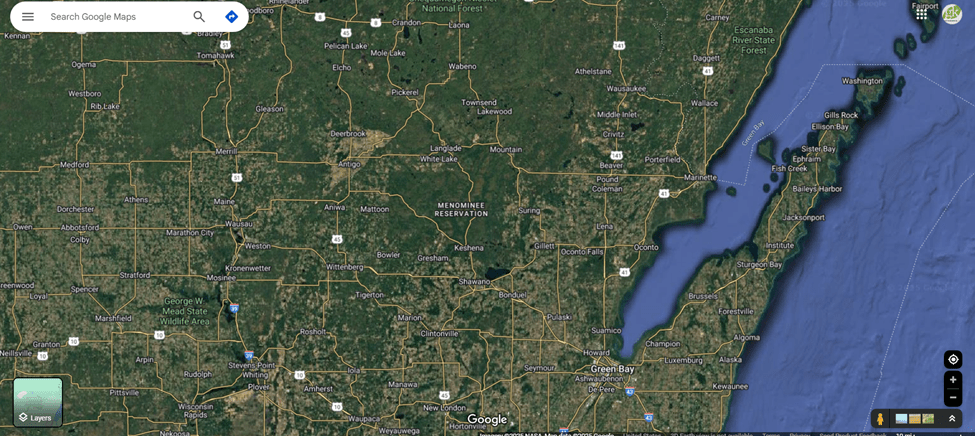
The clear delineation of the reservation shows that first, they are not generally farmers and do not clear the land for farmland. They also probably don’t practice commercial forestry as much as their neighbors.
My most recent visit to Wisconsin was about five months ago. Madison is a place I still recognize, but it seems to be more artificial every time I visit, dominated by jewelry stores and health care facilities, big box stores and strip malls. It’s been a while since I was farther north. The atmospheric density of jewelry stores in Madison has always been a curiosity. I would venture that the proximity to Chicago might have something to do with it, as what better way to launder money than with cash-paying customers, legitimate customers from all over southern Wisconsin, generating the necessary number of legitimate receipts to mask the hijinx. But what do I know?
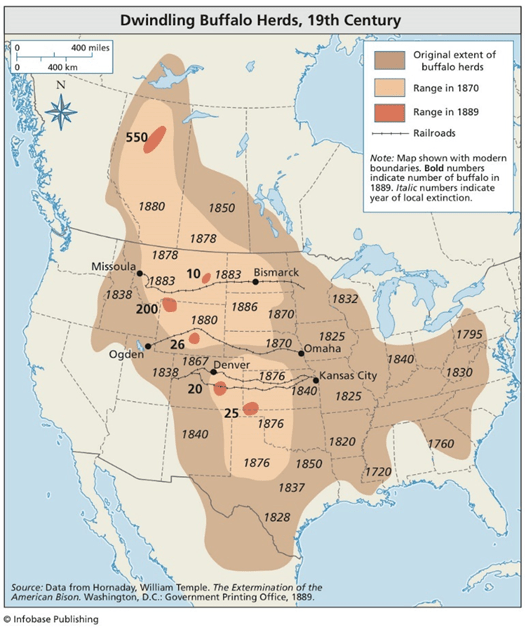
image from:
https://www.buffalofieldcampaign.org/bison-maps

source: wikipedia
At one time, I felt that Wisconsin was a place that I had escaped from. Since then I’ve both tempered my feelings and found out why that is the case. Speaking honestly, it wasn’t what I would call a warm and friendly place, but it did make me part of what I am. For one thing, Wisconsin made me tougher than any Californian, to engage in a bit of hyperbole. It made me other things, too. Knowing Wisconsin has often disappointed me, as there really is no reason to think it’s the best place in the world. There really is no reason to talk with that horrible small-town Wisconsin twang either. There is a conservatism in the Wisconsin spirit as much as there is a progressive tendency, the problem being that many of the smarter people have left. Brain drain is a thing. But thumbs up on the summers and the lakes and the streams and the wildlife and even the weather, which keeps you on your toes.
A complicating factor in Wisconsin culture is alcohol abuse, which is accepted and socially promoted, as mostly every social gathering has booze present. Booze is nearly ever present. It just can’t be a good thing.
Wisconsin tries really hard to make drinking happy.
I’m just not really sure that is completely healthy? And maybe, just maybe, this isn’t something that Wisconsinites should be so proud of.
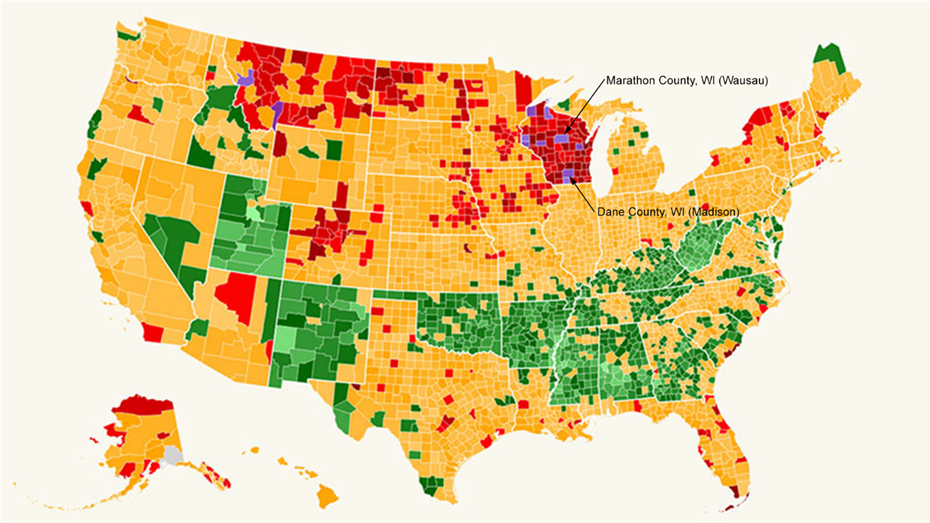
Maybe the cultural focus should be more on doing healthy things, instead of poisoning our bodies with a powerful neurotoxin? I mean, if alcohol was invented today, would it even be legal? Rhetorical question, as it would be instantly be considered illegal under current law, as recreational use of any substance is explicitly not permitted. So no, it would not be considered legal. Of course this is a straw man, as this would be the case for any recreational chemical. Anyway, it’s bad, we all know that. Marathon County and Dane County appear to have about the highest rates of alcohol abuse in the USA. That’s a bit on the nose for this cheesehead.
This map shows CDC rates of alcohol abuse/excessive drinking by county. This is annotated to show the locations of Dane County (Madison) and Marathon County (Wausau).
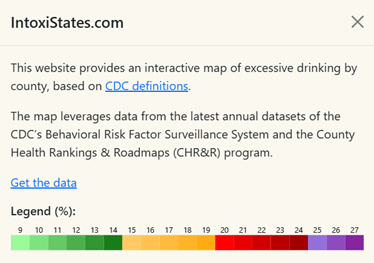
Again, is time a flat circle? Are these great and great great grandchildren reproducing behaviors their ancestors practiced in Deutschland? Do Germans drink like this today? The data appear to say yes, they do, only surpassed by Romania, Georgia, Czech Republic, and Latvia. This WHO data ranks Russia much farther down the list in 27th (2019). So, this data set may be a little sus, but it answers the question. Germans have an impressive ability to drink and have a life expectancy well above that of the USA. I can claim some ability in this arena, and I have enjoyed a liter or two at Oktoberfest in Munich.
But it’s not healthy.
And then there’s those Packer Fans. Packer fandom takes otherwise bleak, gray winter days and makes them fun or annoying. I think it’s a little difficult to live there and avoid the football fervor, but I did it. Not that I don’t like the Pack. In fact, they are the only respectable team in the NFL, in my humble opinion.
Has the author done anything here to distill the Wisconsin person. Perhaps not, but there are observations I’ve made. Wisconsin people are generally honest and hard working. Their work ethic means that they have to work or they will be unworthy. Of what? Perhaps the respect of their community. But therein lies a problem, as communities everywhere are shredding from the onslaught of online culture. Not just that, of course, as the principle reason for cultural change in Wisconsin is the departure of manufacturing and the centralization of agriculture. We romanticize the independent family farmer, but the reality is that this is the exception, not the rule.
One data point is the Marx family, neighbors across the street from my parents, who have maintained their diverse farms for four generations, perhaps five. What sets them apart is the skilled business acumen of the wife, and they have been able to purchase seven other family farms that went under. But generally, everywhere, as in the Great Plains, things have gotten more and more heavy industry. Centralization of food supply is something we all are aware of as we all shop at grocery stores, but the production end of it has changed massively as well. A claim was made to me that the centralization was a scheme by big ag to raise costs for small producers, which seems likely, although I am not an expert on the issue. Suffice it to say that ADM or Monsanto or Landolakes do not want to pay laborers $25/hour with health care if they don’t have to.
At the same time, Wisconsin has gotten … chillier. For instance, two parents at a toddler playground in my hometown, a medium-small northern town, were strapped with firearms. There always was a 10% to 20% of disaffected people, those for whom Wisconsin nice is just bullshit, I would think. This is true everywhere, people who stay rooted to a place, and then, one day, set out for greener pastures. But this is also true for the political climate everywhere in this country, people have lost their communities and seem unwilling to build new ones. This change is not only demographic, with the aging of the Boomer generation, but skews hard in two ways, as the culture has changed on the younger side.
The lack of interest in the physical world is real. For instance, take that pillar of Wisconsin culture, deer hunting. The white tail deer herd is Wisconsin is constantly over 1.5 million, but the annual harvest numbers have fallen, and hover around 300,000. The DNR has a goal of a herd size of about 800,000, but there hasn’t been enough hunting to keep up. Meanwhile, some farmers complain about wolves. And Chronic Wasting Disease, and other pathogens, are now widespread in the herd.
“https://www.wpr.org/news/deer-test-positive-chronic-wasting-disease-2023“
Here I could digress and discuss, again, land use and culture, and how the DNR has maintained a dangerously large herd to keep hunters happy. At the same time, hunters have shown a lot of interest in killing wolves, now prohibited by Federal law.
But back to sports! The Packers seem to have supplanted Jesus, hunting, fishing, and other weekend endeavors in the Wisconsin culture. Perhaps people are more interested in watching large men stand around than hunt? Perhaps we can’t place all of the blame for Chronic Wasting Disease in the Wisconsin white tail deer her at the foot of social media?
It goes a little too far, to the point that the forest is not see for the trees. But to some the season of mud is just a prelude to snowmobiling season.
If you know, you know, that there is a lot out there however you want to travel.
The sheer conformity of the Packers merch during football season, in what seems to be a social adaptation to resist the weather and climate, and the conformity of the culture itself. Clearly, the Wisconsin spirit makes the Green Bay Packers possible.
It’s true that you’ll have a much better time in Wisconsin with a positive mental attitude. In fact, you might even vibe with the locals.
But, growing up, we didn’t complain about the weather. We appreciated that it had to be dealt with, and observed the adage that there is no bad weather, just the wrong gear. And it does change faster than anywhere, with the low pressure systems zipping across this part of the midwest. These days we are relatively comfort loving, and life is centered around the couch and the entertainment center. Decrying something doesn’t change a thing, but awareness of issues can allow change.
And this is where I make my thesis. Wisconsin people are honest and industrious and hard working, but they have been resistant to change, and have instead been changed by external factors.
When I was a kid in northern Wisconsin, it was common for people to just slide off into the ditch. Wisconsin is famous for hazardous driving conditions, as it’s a wetter variety of weather than its neighbors commonly experience, lake effect snow notwithstanding. And when this happened, people would just wait, stay in their cars if it’s very cold, and eventually there would be a knock at the window, “Do you need help?” And then another car or truck would stop, and another. This happened to me, and soon there were seven people pushing my Ford escort out of the ditch. I’m certain this still occurs, although snow itself is rarer these days.
Wisconsin people are generally very conformist, eschewing even brightly colored vehicles. But the land they have inherited is not tame. The land of Wisconsin is often very wild and wet and beautiful. It also has such a collection of quaint small towns that a coffee table book is deserved. It’s a great weekend road trip from Chicagoland!
 Graham Knopp's Blog
Please leave a comment. I will respond.