Copyright 2025 Graham Paul Knopp
The town of Stettin, just west of Wausau, Wisconsin is an area of rolling hills and running streams, interrupted by ponds and marshes. It’s a beautiful land that has praries in the high places, and deep woods in the low places, which teem with wildlife.
In 1975, my parents bought a 40-acre property with a stream running through it, Little Creek, which flows into the Little Rib River, which flows into the Rib River, which flows into the Wisconsin River, which flows into the Mississippi River. Little Creek always ran.
When our house was built and we moved in, the land looked a bit trashed in places, from a mining company looking for zircon, who constructed various ponds and quarries. The geology in the area is interesting, and brought college geology field trips to our property, but that’s another story. What’s important here is that the mining company had built a pond with an earthen dam to have enough water to wash their gravel or ore. This was gone from a flood by the time we arrived, but my Father wanted to restore the dam and have a pond again. He was nothing if not industrious, and hauled loads of concrete blocks and concrete down to the pond. This experiment did not last long before it was supplanted by a beaver dam. And what a marvel of engineering this dam was. As it expanded the pond out into the relatively flat flood plain, it had to be very long. I’d honestly estimate it was 100 yards long, and I did manage to walk across it in both summer and winter. Yes, it was sturdy enough to walk across, buttressed by countless small branches, mostly poplar, a northern cottonwood. In between the sticks, perhaps the most amazing thing of all, these industrious rodents pack mud. They certainly push up mud from areas adjacent to the dam, but there is so much packed mud that they must excavate and fill, much like human engineers. Perhaps their underwater activities have been recorded? [yes, Nature Season 32 Episode 17, “Leave it to Beavers”) At its highest, by the stream channel, it was about six feet high.
At this point, the beavers were not known to me by sight. But soon, a walk down the hill and along the old fire road to the pond was my daily constitutional, and I soon started to get glimpses of our residents. But one thing frustrated me. Even if I was very quiet, they would slap their tails before I could get close, and then would disappear.
Over several seasons, they got used to my presence and would look at me while swimming, usually on the far side where the Brown’s property line crossed. But not before they popped out several seasons of pups. Now, I don’t know how much the reader knows about these extraordinary creatures, these funny little aquatic creatures, other than that they are amazing engineers. They are also obdurate parents, which is to say that they don’t like to parent because they soon begin to fight with their young, to make them go away and do what god has said they have to do: eat bark, and make dams anr more beavers, of course. And they certainly do proliferate. Evidence of this is the beaver dam seen in the drainage ditch behind my hotel parking lot in urban New Jersey.
Nature is a funny thing. I once had a physics professor who would say, “If it is possible, meaning it obeys the laws of physics, then it exists in this Universe.” And that is how nature works through mutations over genetic time, eventually finding this specific form, the American Beaver, by way of its well-described ancestry going back about 30 million years.
But this is their way, to kick their young out so they can go multiply and create ponds and consequent meadows all along the course of the stream and other tributaries along the rivers downstream, creating ponds and meadows all along. These fights certainly sounded violent, as their snarling would carry up to the house, filling quiet springtime evenings with the unsettling family drama from the neighbors who live down by the stream.
The creation of meadows happens when the beavers exhaust the supply of their favorite trees nearby, aspens, poplars, or cottonwoods, willow, oak, and maple. Then they move away, the pond dissolving into a meadow of wetland grasses. Then the trees grow, and the cycle begins again.
As they were so shy, it was difficult to get near, but there were several events when I surprised them at a distance from the pond, and they would scatter back, usually after one single look back, running for their dear lives, not taking any chances. This was in the days before the return of the coyote, which is now an important predator. The distance they can safely travel in a particular place is probably a key factor in their longevity.
And they did depart, at least this little stretch of little creek, but not for perhaps seven years.
One year, a family that was possibly made up of their pups made a home a few hundred yards downstream, where the stream exited our property through a culvert under County Highway O. The location of their dam was quite clever, and utilized the roadway fill as part of the dam. My Dad said that they were, “damn smart engineers.” Suffice it to say, the county engineers determined that the added flooding to the side of the roadway was unacceptable, as it was likely not engineered to be a levee, and the dam was removed. Not understanding the engineering issues at hand, I felt violated. My sister said something and reacted oddly when I tossed a banana peel off the porch, accusing me of littering. I pointed out that it was a banana peel and I knew where it was and would be certain not to slip on it, and that she should also be careful. She smiled, realizing that she was angry about the perceived violation, and we both looked at each other, understanding that we both felt the same way.
The family left that property a few years later, and I’m certain that the American Beaver still works the tributaries of the Rib River. What else are they going to do? to college?
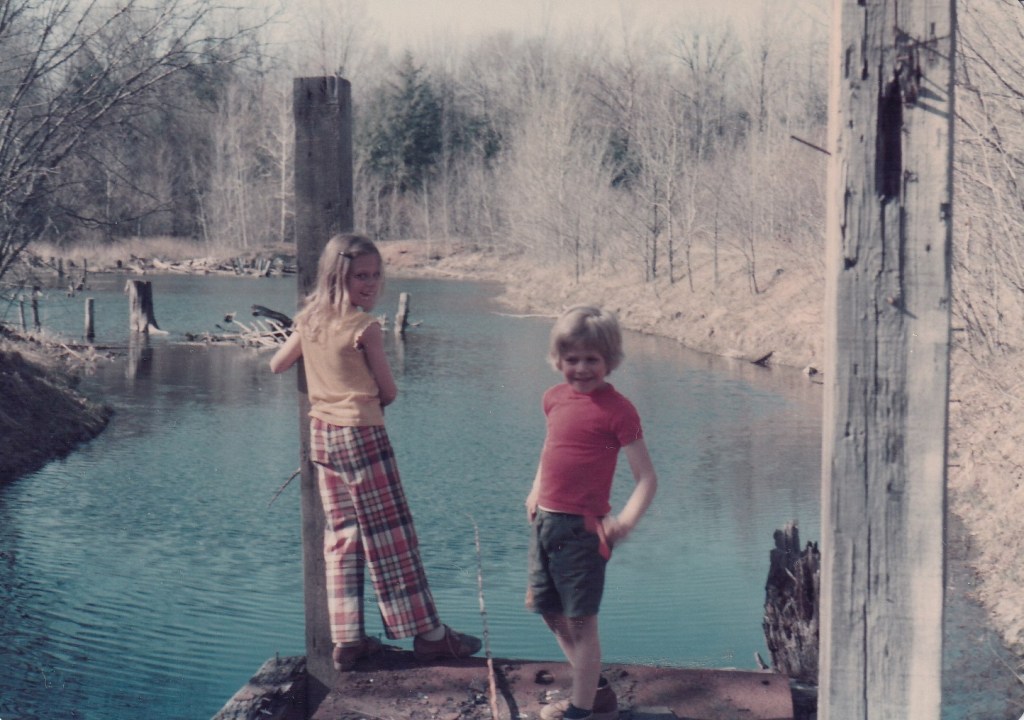
The pond before the beavers came, maybe 1975. Flow was out through the dam near the center left. The mining company had left this old dock.

On the pond in the winter. The tree stumps behind killed when the pond was flooded by the beaver dam, but were on the neighbors’ property were logged by them. Taking all of them would not have been my Dad’s practice.

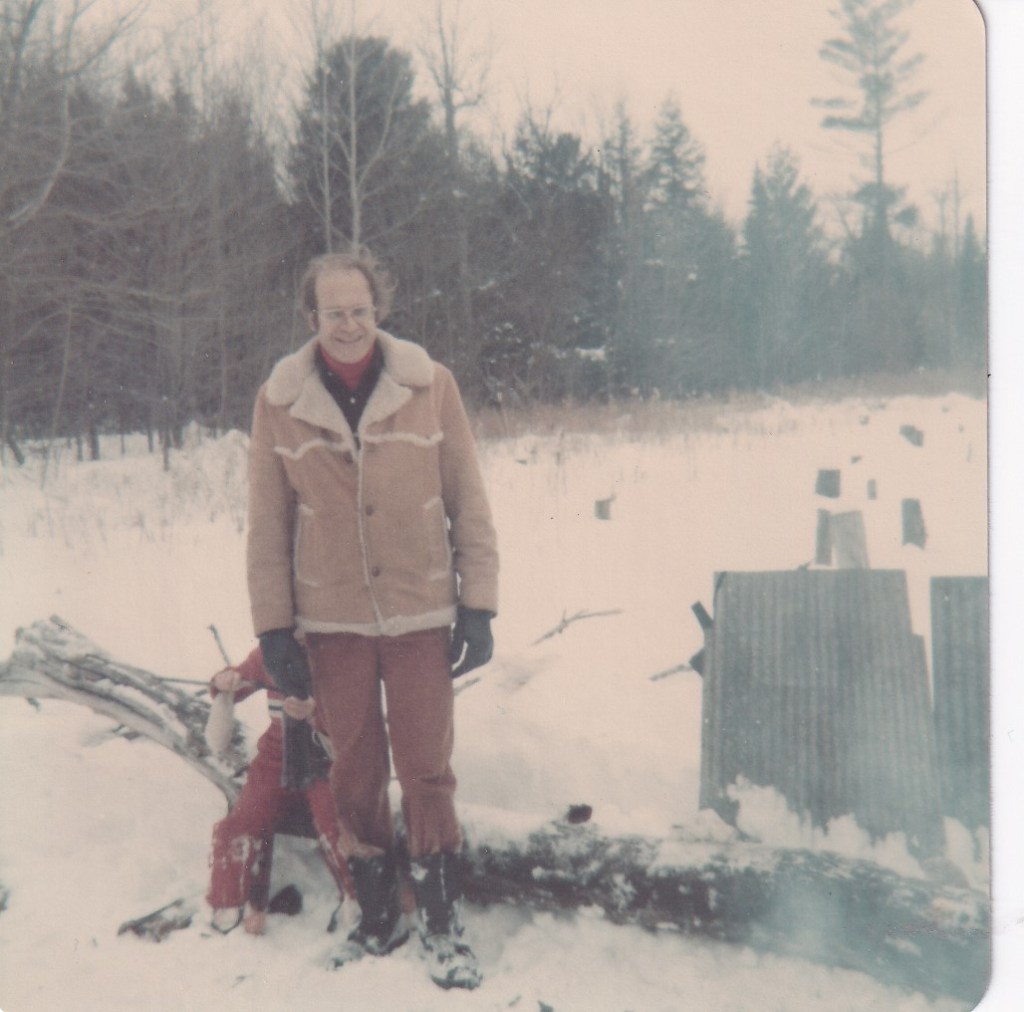
My Dad circa 1977, on the pond.
 Graham Knopp's Blog
Please leave a comment. I will respond.