Copyright Graham Paul Knopp 2025
This is a short story about a wildlife encounter in which I say “I” far more frequently than I am comfortable with.
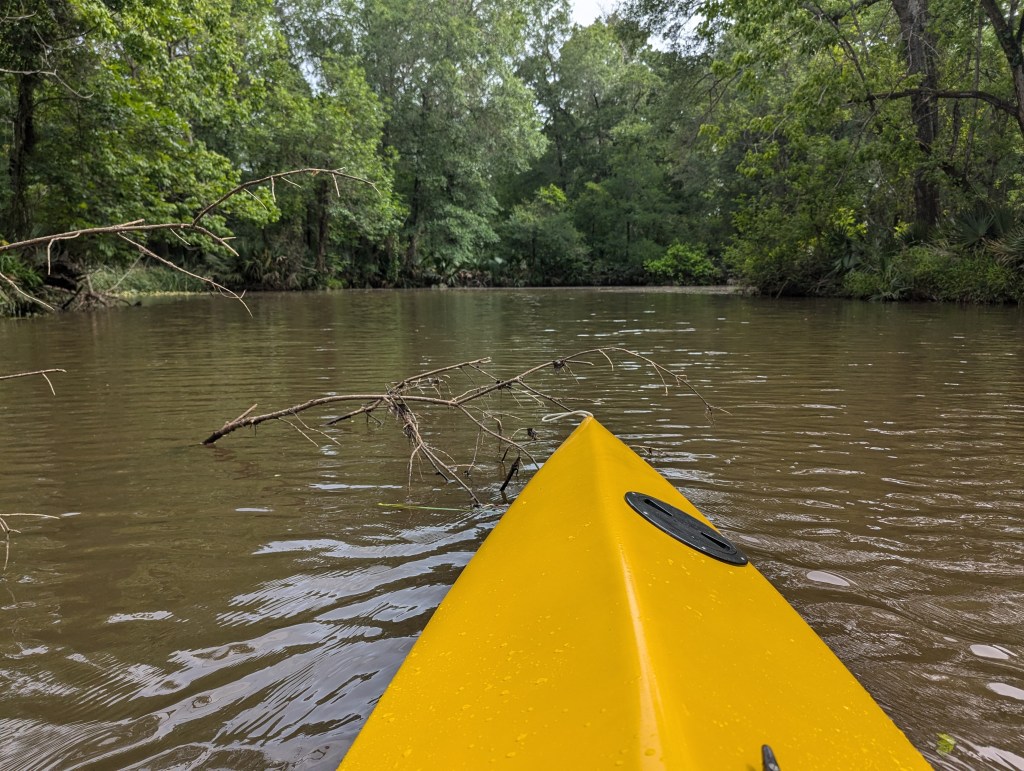
So I’m paddling Lake Conroe in the bayou north from the Stubblefield Lake Road boat ramp, which is a reservoir, so you’re paddling up this flooded stream channel, and it has all of the windings and bends of the submerged old stream channel several murky feet below. The mysteriousness of paddling over inky black water and knowing there are creatures there heightens the fun.
Something large splashes into the water, pushing water towards me as a warning. I did not see it, though it was probably a small gator. And there is wildlife and the species list is already long. Turtles, herons, gators and giant catfish, this dank and fecund water body is alive. Also worth noting is that this is the edge of the Big Piney, an ecological wonder of global importance in terms of biodiversity.
Heading upriver slowly, with the wind, I spy a bald eagle above the tree tops of a tall loblolly pine. Later, its shadow passes over my big yellow boat.
On a bend in the river, a duck notices me, and takes off, but doesn’t take off, and swims upstream, looking waterlogged if a duck can look wet. This bird swims quite well, doing this butterfly stroke (or “duck” stroke), until it’s out of sight, and I am left trying to figure out why it swims so well when it is injured.
It continued swimming upstream in front of me, and eventually went around a bend in the river. Now it had occurred to me that the bird looked pretty comfortable swimming like that, and it did seem a little too deliberate, which might imply that it was feigning injury to attract me, presumably because there are little ones around.
I continued on, rounding a bend in the river and the flock is there, the mother, probably, and her brood of about nine tiny little ducklings. In a tightly bunched float, raft, or flock, all are terms for a bunch of ducklings. They are so tiny that they have trouble keeping up with her as they move away. So tiny, I know, they would each fit in the palm of one’s hand. This gets old, and I try to pass them when an island appears. Then I give up trying to pass, as they won’t let me, and the little ones are a little distressed, not being able to keep up. So we settle down to a calmer pace, which they seem comfortable with, and we all move together upriver and downwind. Bending around bend after bend in this lazy river. It’s a little slow for my pace, but on these group paddles, you have to go with the flow sometimes.
On a straighter section, they hug the side, the bank, in shadow.
I’m perhaps looking at something in the water near me, an overhanging branch in the water, when there is a disturbance, and a bald eagle has pounced on the flock. In that instant, I see the eagle with open wings, facing me, suspended above the water, with talons extended, tail feathers fanned out, but the talons were empty. The mother duck lunges for the body of the eagle. When I think back about what I can remember from this event, I seem to remember details within instants. But I remind myself that this was one sudden, continuous movement. In that next instant, with the mommy duck attacking and the eagle’s first attempt to snatch a duckling having failed, the eagle reversed course, flapped twice forcefully and then was gone, having launched itself above the treetops in a third instant, leaving the scene quiet, as it had been only five seconds prior. The transient perturbation behind them small family, came back to order, and allowed me to pass.
The eagle was not completely gone, and I saw it at least once later. So much effort for perhaps one tasty little duckling. Perhaps like many Americans, this Eagle doesn’t have a taste for freshwater fish.
Point 1: The big yellow kayak was a warning to both the birds and the eagle, and likely played a part in the eagle’s retreat, as my boat was only about 40 feet away.
Point 2: The duck family knew they were being hunted and were in distress, which I failed to realize. My actions may have pushed them into a fatal situation. But these little guys were too small and too slow and needed better cover. It’s unlikely that many of them will survive.
Point 3: These ducks thought that I was an equivalent threat as a bald eagle. Mas y menos.
As an aside, I’ll also share that this was my second paddle with this kayak. The first was a test run at Kickerillo Preserve in suburban Houston. There are many waterfowl in this smaller water body and many small watercraft, and always line fishermen. I was about finished with my paddle and was headed to the dirt launch when I saw a cormorant in apparent distress about 20 feet from the ramp. It seemed unable to get out of the water. Floating quietly closer, the bird appeared to be entangled in fishing line also wrapped around a branch in the water. The bird would probably die. I had neither gloves nor a knife, but I floated in to help.
Now I’m not a total bleeding heart, and understand nature pretty well, but I know that I would feel worse about myself if I did nothing. So I moved in to help with the understanding that it was about me.
Creeping alongside the panicked bird decided that I was the larger problem, and entanglement could wait until after it attacked me. So, while trying to untangle the line, some of which was wrapped somewhat tightly around the right wind, the bird bit me as hard as it could, several times, but had no sharp teeth and I was fine with this, as it distracted the bird while I tried to finagle the line from its wing. So the bird went to Plan B, which was to stab me with its beak barb, which did break my skin. Plan B for me, too. I tried distracting the bird with my left hand, mostly succeeding at not getting stabbed, while I worked the line with the other. I’m sure the bird was thinking my fingers looked very edible at that point. In this tussle, my paddle floated away. The cormorant succeeded at stabbing me perhaps one more time before it was freed and flopped away, half swimming, half flying, and not looking back.
[An anonymous source, perhaps a little bird, told me that cormorants are assholes. As a student of animal behavior, I would just say that they are very birdy. Bird brains are different than mammal brains. I’m not sure why this source thinks that cormorants are jerks.]
I’ll save forays into the subject of animal culture for other articles. Academia, let it be said, has a nonsensical and obstinate view of animal culture along the lines of, “Don’t think about it because it doesn’t exist.” Their rationale is one of personification, as they have everyone convinced that talking about animal culture is equivalent to personification, which is the high crime of bad science. The reality is that what they are doing is taking the animal out of the animal. Modern biology does itself a disservice.
Trail maps and virtually all the information you need at:
Also see the FB group Lone Star Hiking Trail
 Graham Knopp's Blog
Please leave a comment. I will respond.