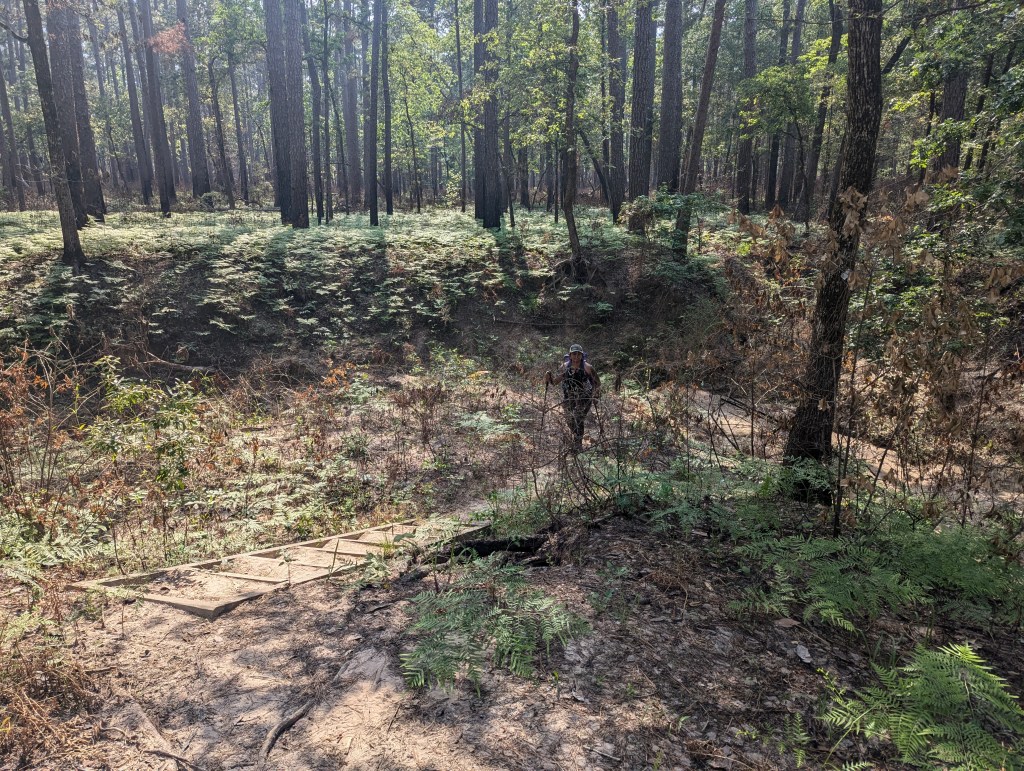
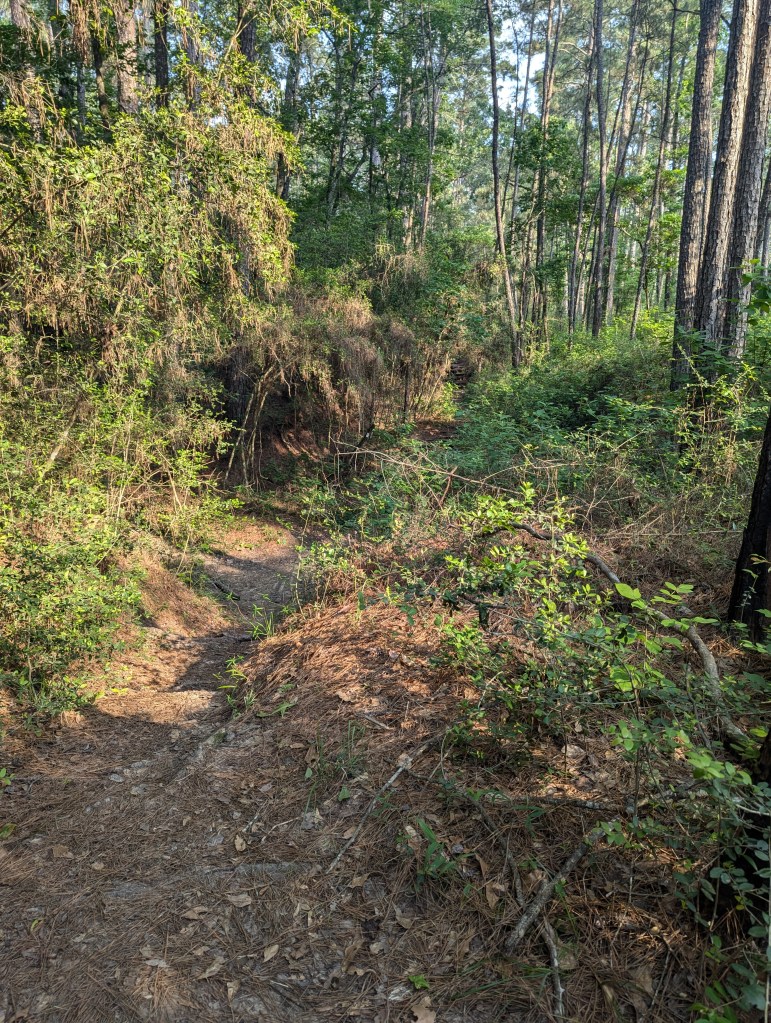
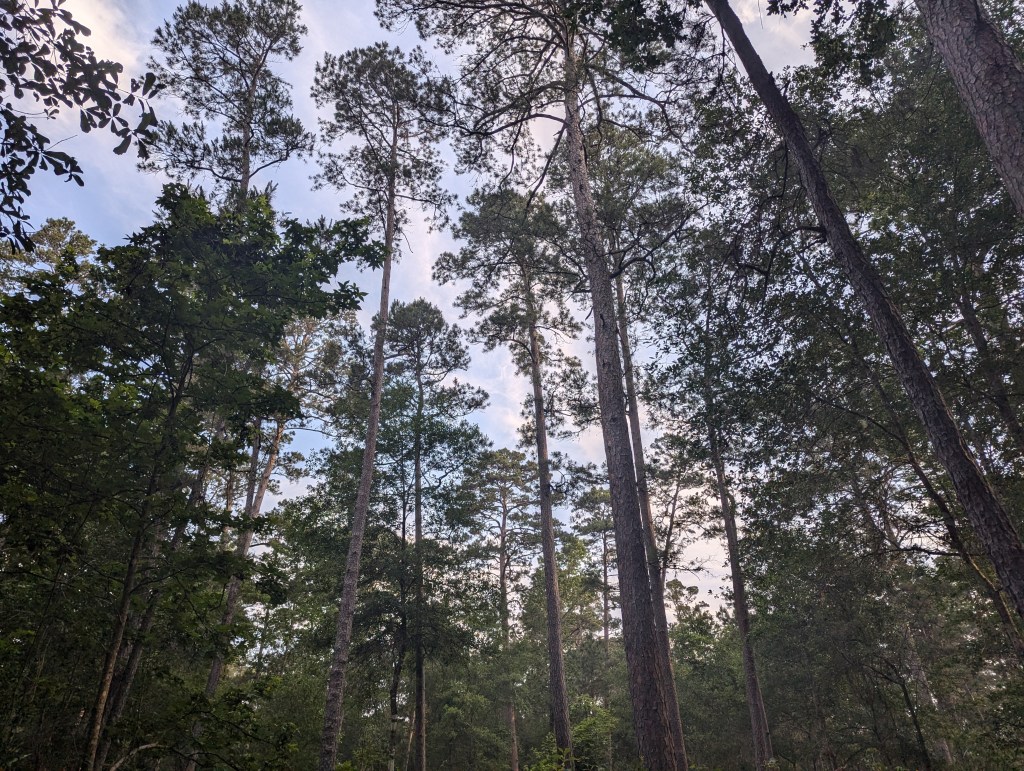
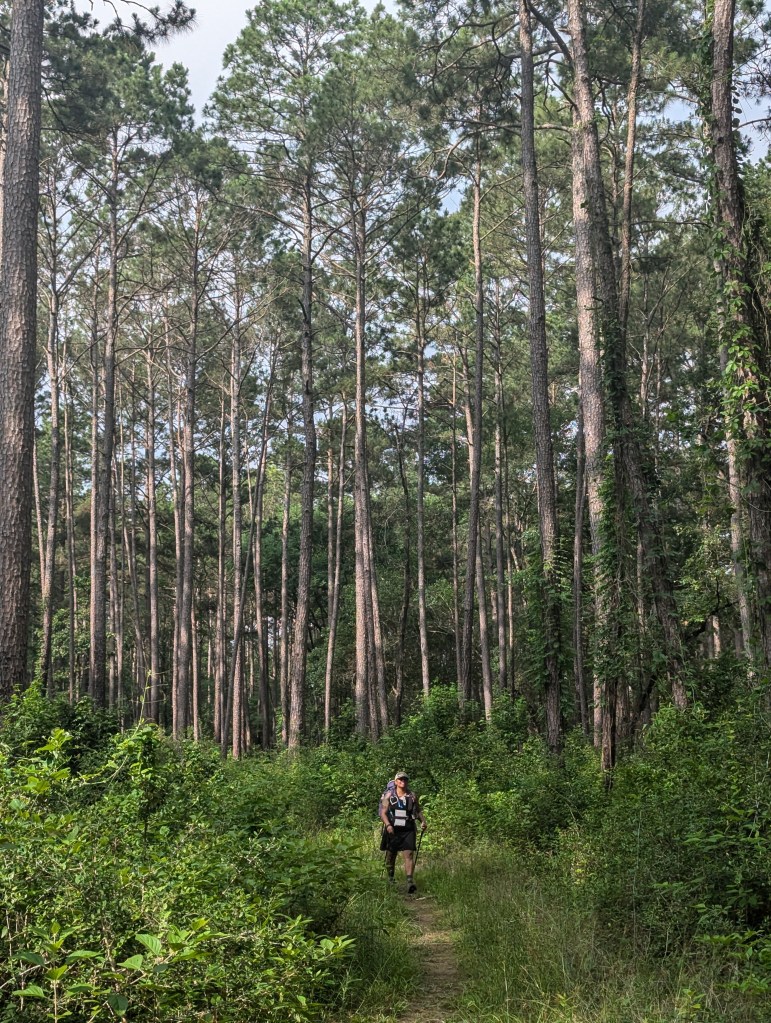
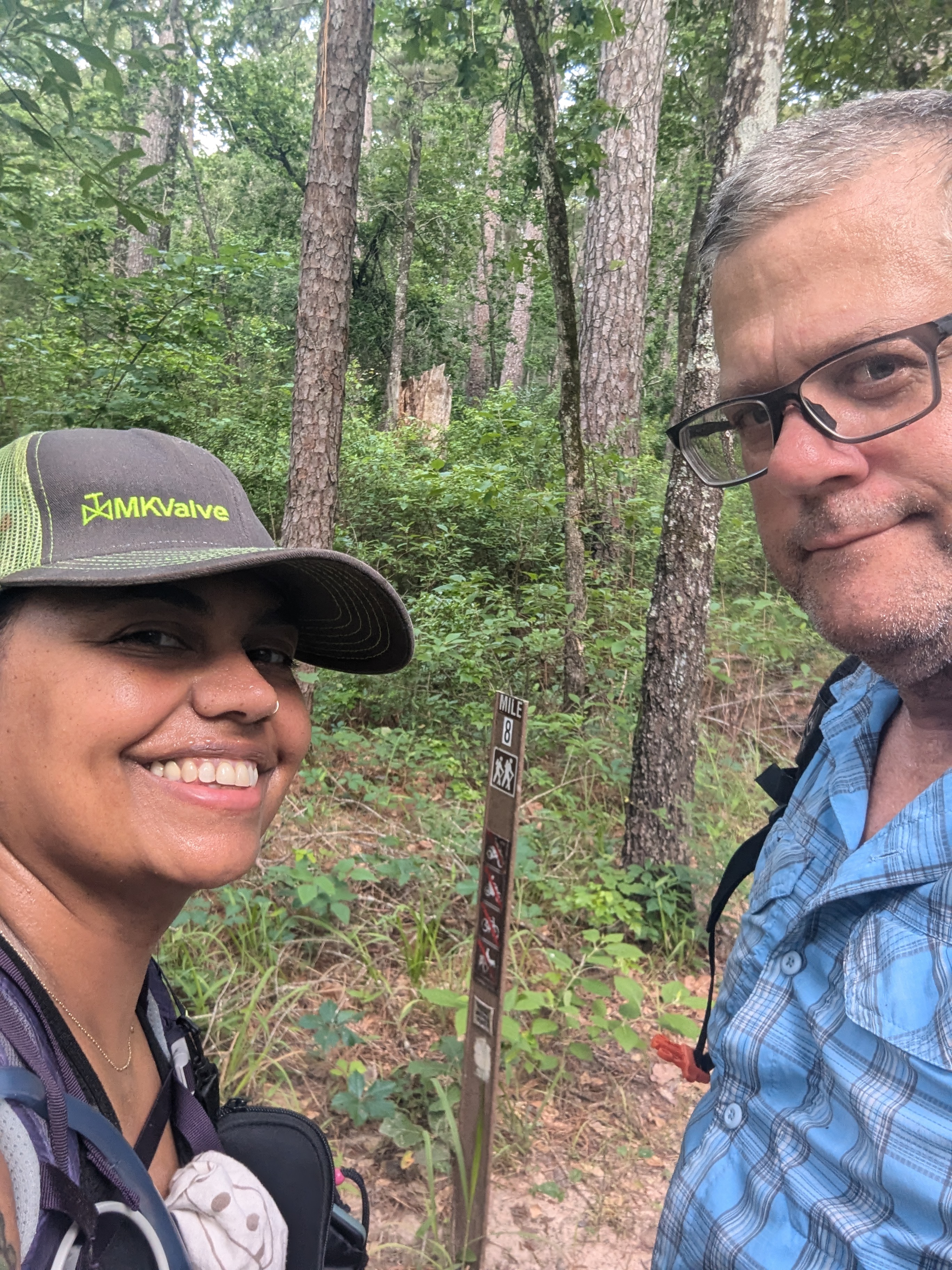
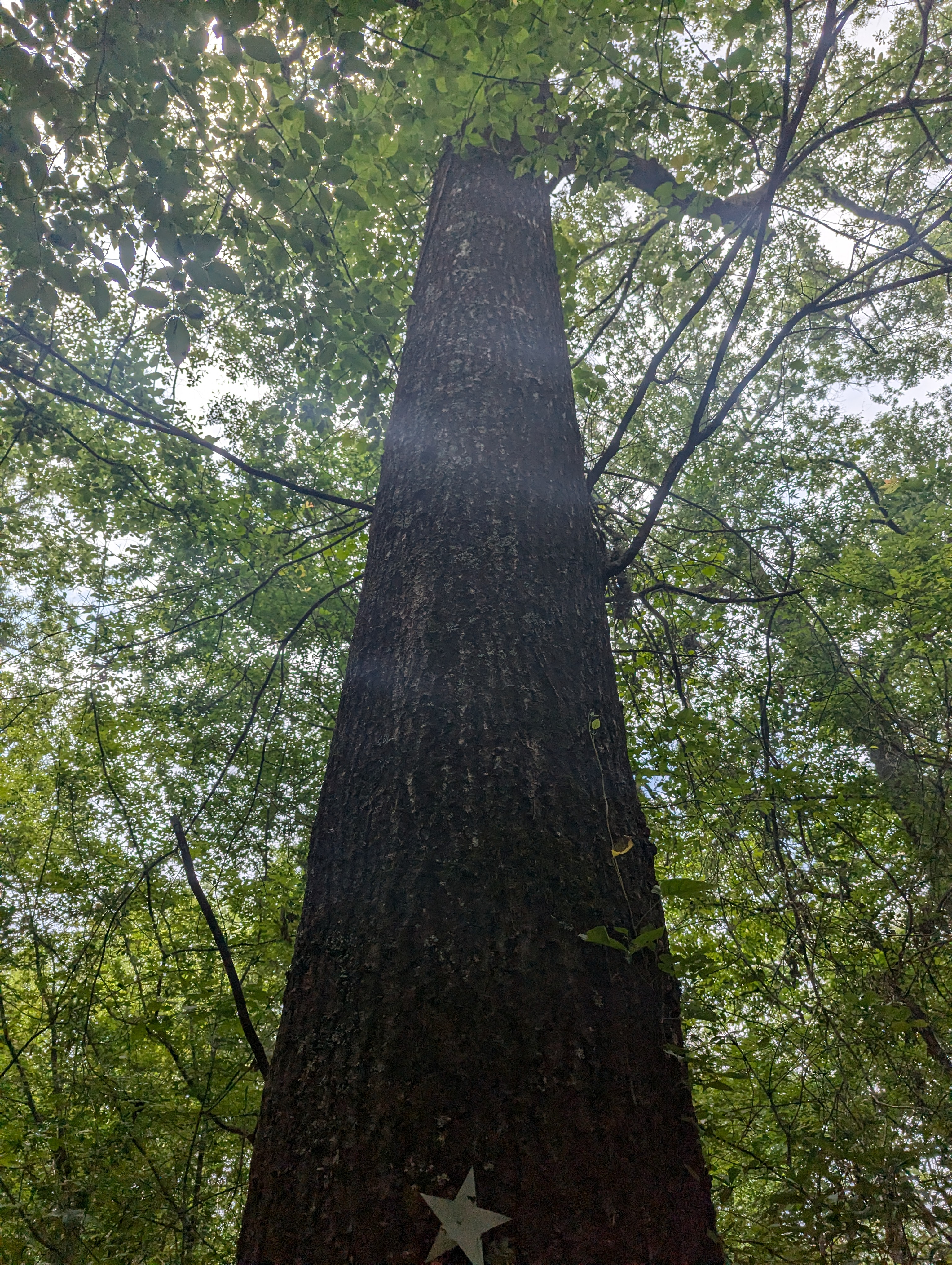
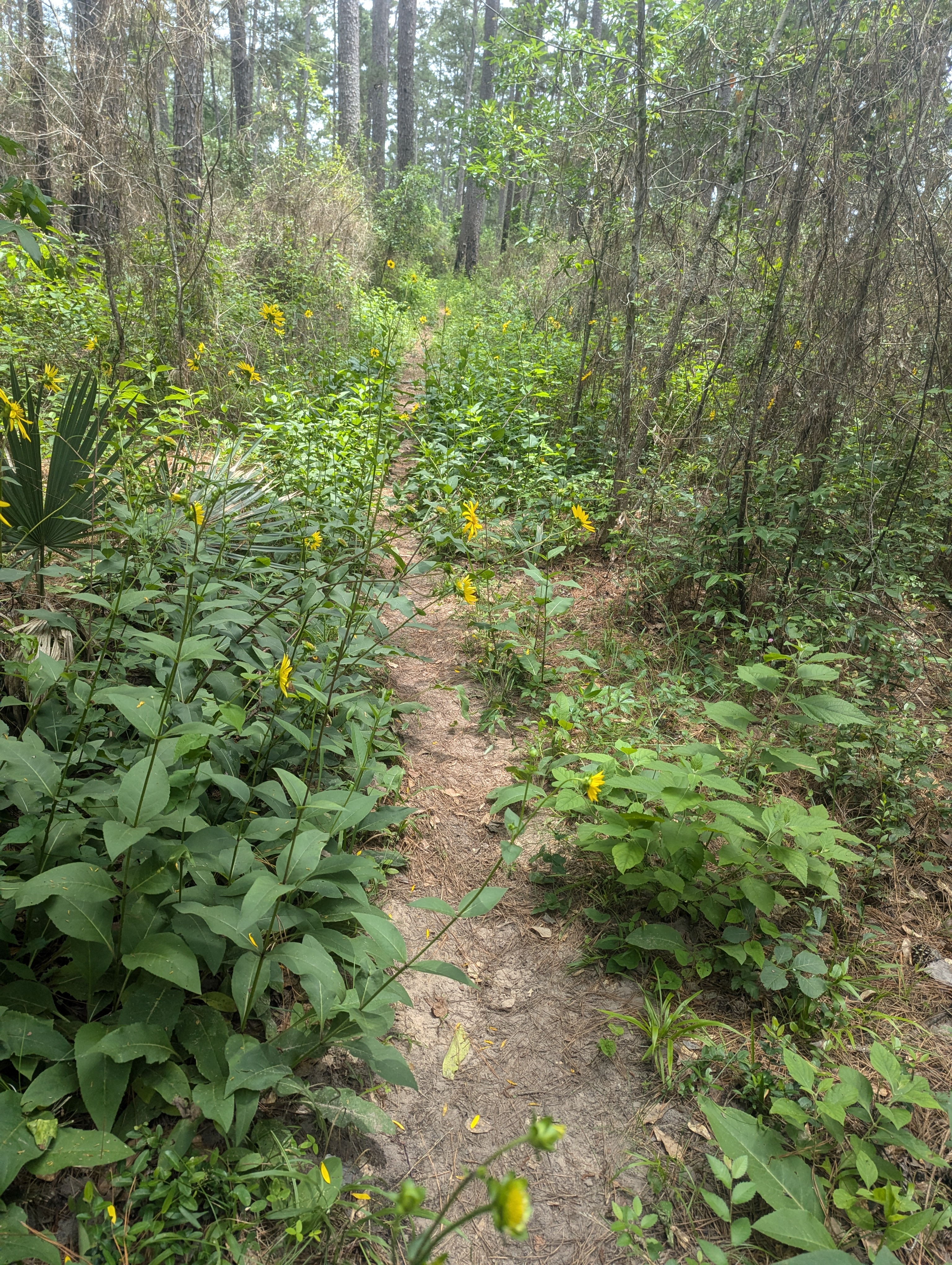
This is a trail report for the first 14.5 miles of the Lone Star Trail north of Houston in the Sam Houston National Forest. The Lone Star Trail is about 90 miles long, with about 37 miles of alternates, and is continuous with a few road sections, but is mostly wildernessy singletrack. It meanders through the bogs, pine forests and mixed hardwood habitats of the margin of the Big Piney Woods ecoregion, which has an astounding level of biodiversity, where it isn’t composed of yellow pine plantations. But those are more in Louisiana and Mississippi.
Resources and Merlin app species list is at the end.
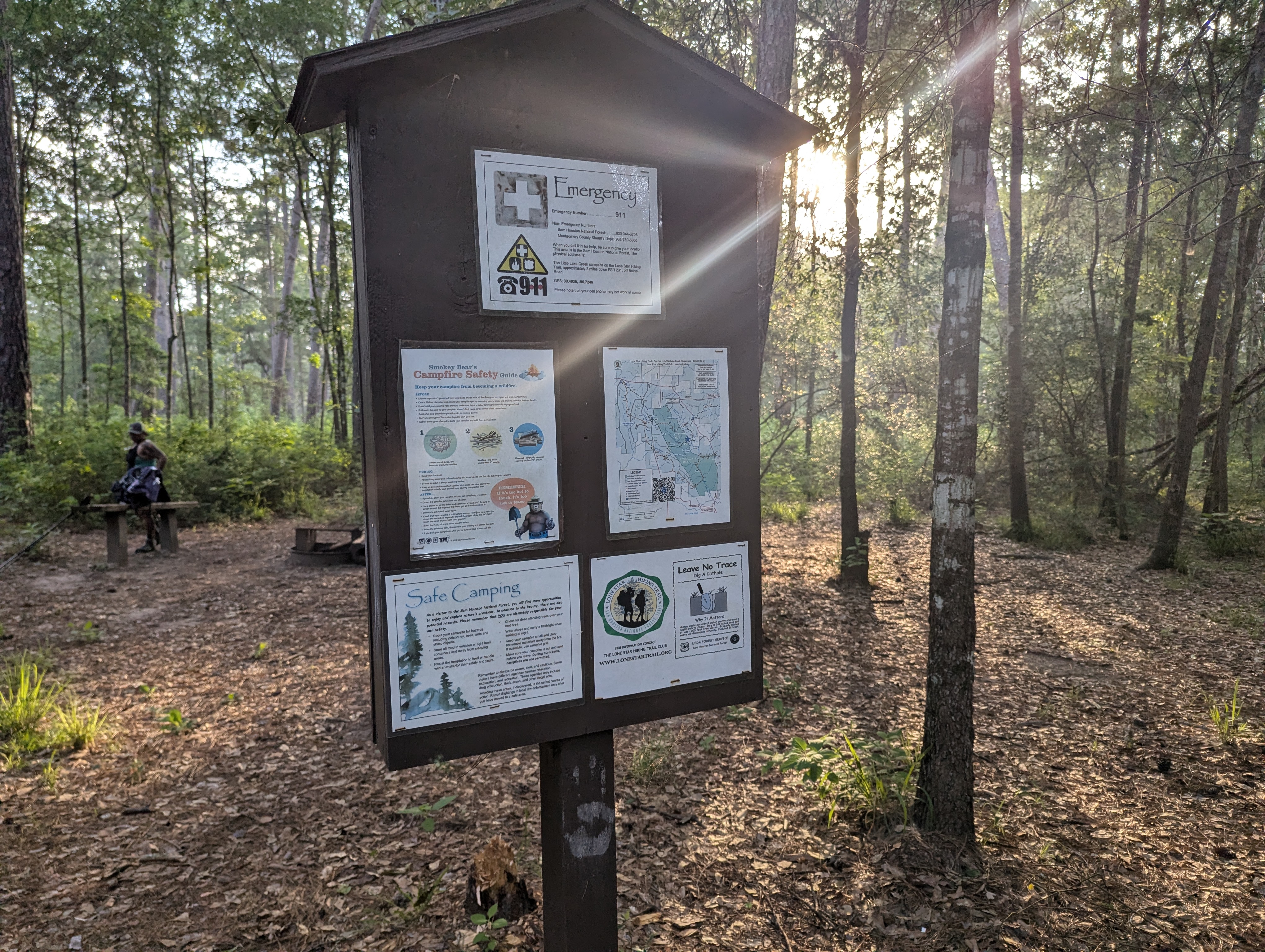
Given various factors including a torn calf muscle, not having done much hiking recently, and the heat, we elected to leave a vehicle at mm 0, TH 1 near Richards, Texas. I was fairly certain we could make it to the section that roughly parallels FM 1375 and find one of several cutoff options. Next time, now that we have a gauge of our capabilities, we will likely drive two cars and leave one at our goal. Yes, there is no correspondence between the trailhead naming and the mileage.
The heat. Texas heat is special, but is probably not any worse than heat across the tropical world, like on the Veracruz, or Mosquito, Coast to the south of the border. It’s stupendous and oppressive, stupifying and unrelenting. It’s the reason that some people can’t live here and it’s the reason that many Texans unfortunately live soft lives in air conditioned comfort. It helps to have cheap energy. Many do not, of course, and to work outside here requires a special kind of heat resilience that proscribes poor health, but often does require siestas during the heat of the day. Texas heat is indeed a blend of Mexican heat, powered by tropical thermal energy coming off of the Gulf of Mexico, the onshore flow and ridging over the central USA, a hot and dry furnace blast hits us from the north, mixing with the tropical humidity. It’s rather like a sauna, and makes one wonder why people settled this place prior to air conditioning. But people settled even hotter places, of course, and I am reminded that I am from Wisconsin and have very little experience backpacking in both heat and humidity. Desert heat, however, plenty. So, a person can get used to it, given you’re healthy. And that’s the goal here, get used to it. I live here, why shouldn’t I be able to tolerate being outside in 100 F plus heat index weather for more than 24 hours? It’s sad that I’ve become so accustomed to softness. But I do like my Verlo mattress.
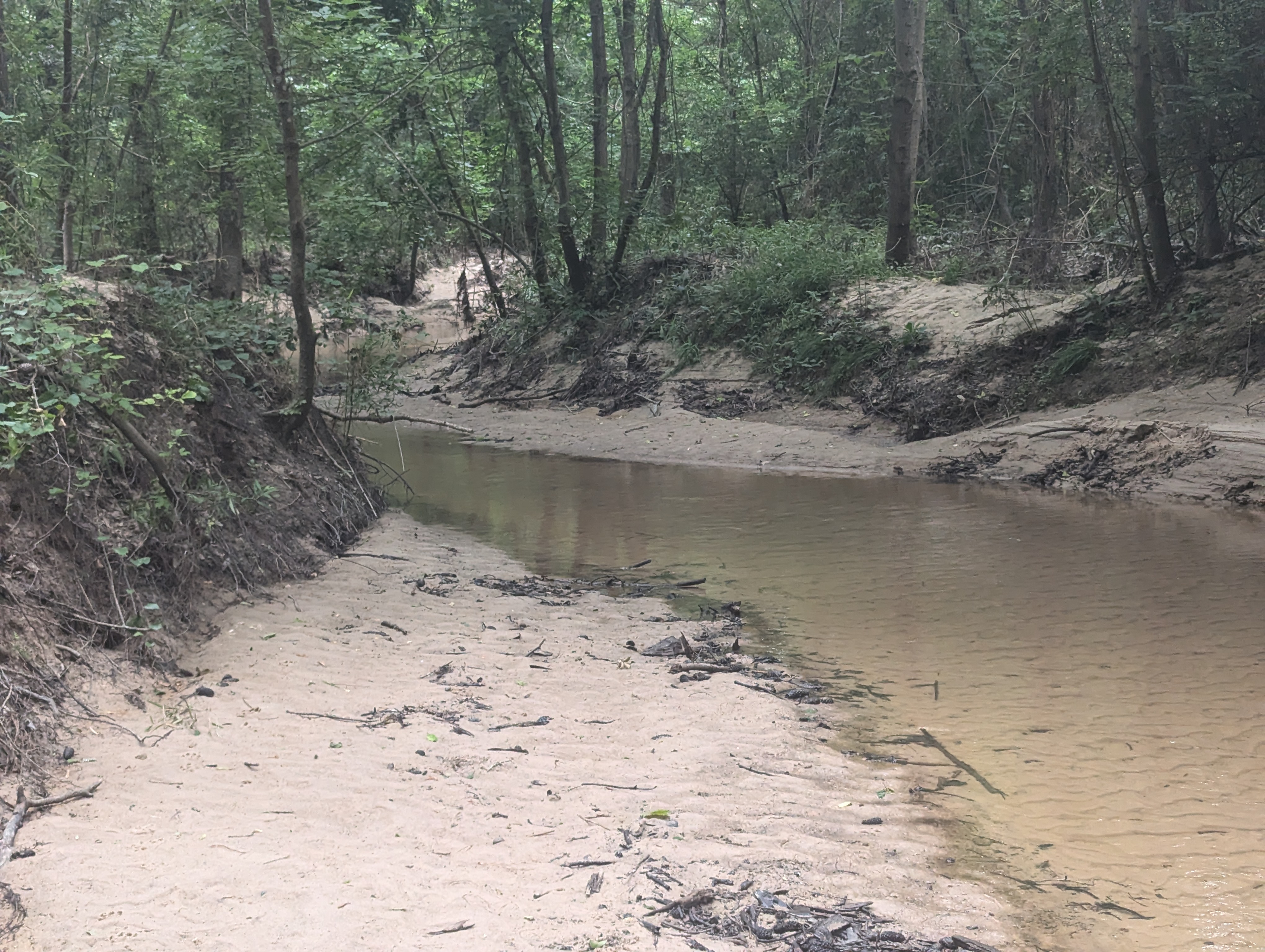
And this isn’t Wisconsin, the soil is a mix of marine sediments, with sparse soil cover and very little organic matter, often clayey in places. Boggy areas form in poorly drained areas and collect organic matter. These become their own little biomes within the forest, creepy, slimy places full or creepy, slithering swamp creatures like the people from Louisiana.
Speaking of creepy, it became obvious to me that something strange was going on when I noticed that the forest floor everywhere was not surfaced with leaf and pine needle litter, it was surfaced by a fairly uniform gray sand. The forest floor was being churned by billions of ants and other insects, but mostly ants. There was no where to place a tent, everywhere was ants, or at least the gray sand that they excavated while consuming the leaf litter constantly dropped, pulling it down into their burrows.
Mushrooms were everywhere, but few that I could positively ID. One stinkhorn, and a few clusters of gorgeous orange caps. The fungus doing their work, turning minerals into energy, making them available for other organisms to use.
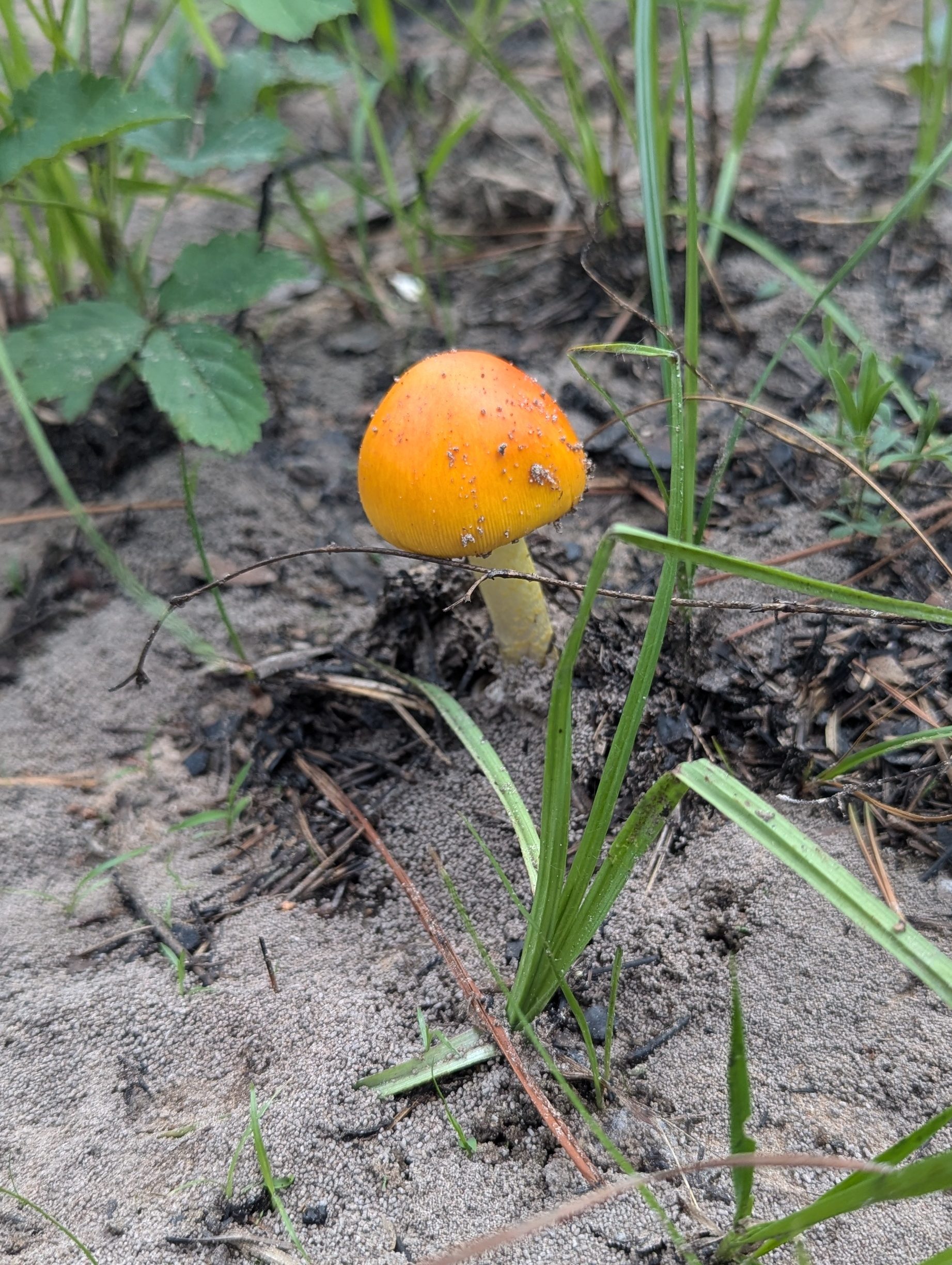
The subject of soil biomes is trendy, so one salient fact seems appropriate, that the total fungal biomass in soil is much greater than the microbial biomass. The fungi do the essential work of making nutrients available.
In Texas, spring come fast, and then it’s summer before you know it. But even in mid-march, fully three months after the Winter Solstice, when there is already plenty of sunlight for the plants to grow, not much grows. The plants wait sensibly for it to warm up. Well, not quite. The plants are actually waiting for the soil biome to develop, which releases nutrients, from soil weathering and nitrogen fixation.
Merlin species list:Do the ants farm fungi? They would appear to live within the habitat of the soil fungi.
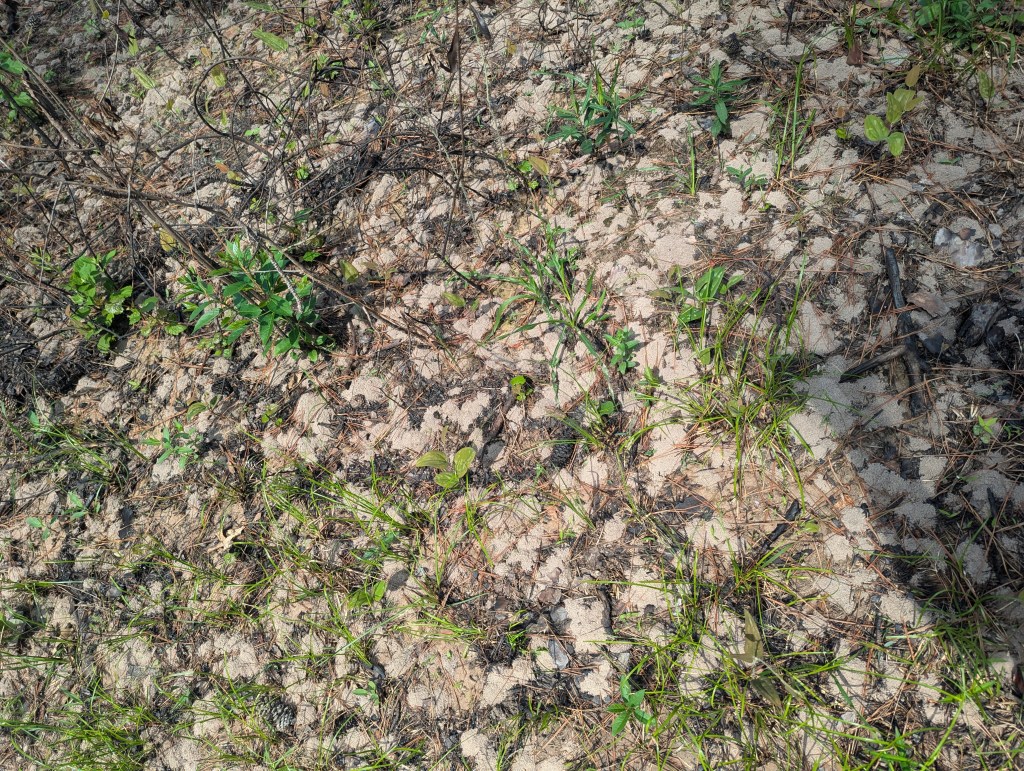
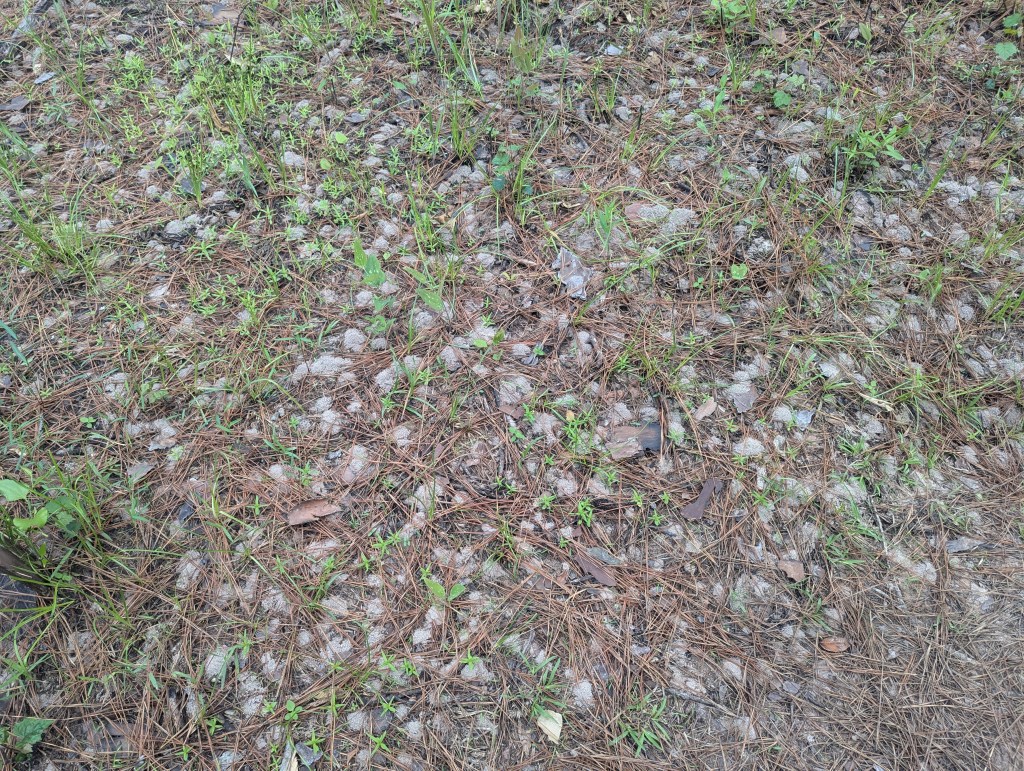
The ants churn the soil and consume litter. The light spots are anthills. They make the soil porous with their tunneling. Nowhere to put a tent for miles.
On this day the heat index was well into the 100s, with very high humidity, just enough to make just several raindrops when it cooled down in the evening. Yes, the heavens were teasing us. Just enough dampness to bring the tree frogs down from their trees onto the ground where they chirped at each other on all sides of our camp site. I ran the Merlin app, which misidentified the tree frogs as a bird, but I resolved that issue in the hammock around midnight when it finally cooled down and the species list is shown below. Around midnight a barred owl paid a visit, flying off after two songs, two long hoots.
The Lone Star Trail is a special trail. It maintains a wildernessy feel and, in fact, this first little section crosses the Little Creek Wilderness. The Lone Star Trail is well-cared for, and is the only such trail in maybe all of Texas, with the possible exception of Big Bend National Park. However, the Lone Star Trail is more suited for multi-day backpacking than hikes in Big Bend, which is more suited to day hikes. The water situation depends on recent weather, and I would not recommend hiking this trail in the summer months. Because road access is generally easy, one might consider caching water before starting. Experienced backpackers tend to favor alpine and montane terrains, but for contrast even the most experienced backpackers give the Lone Star Trail a try.
Merlin app species list:
- Carolina Wren
- Barred Owl
- Bald Eagle
- Indigo Bunting
- Blue Jay
- Yellow-Throated Vireo
- Mourning Dove
- Great Egret
- Pine Warbler
- Tufted titmouse
- White-eyed vireo
- American Crow
- Northern Cardinal
- Yellow-billed Cuckoo
- Red-eyed vireo
- Black Bellied Whistling Duck
- Red-Bellied Woodpecker
- Carolina Chickadee
- Summer Tanager
- Northern Rough-winged swallow
- Eastern Wood-Pewee
- Common yellowthroat
- Downy Woodpecker
- American Robin
- Wood Thrush
- Rock Pigeon
- Blue-gray Gnatcatcher
- Red-breasted Nuthatch
- Red-shouldered Hawk
- Acadian Flycatcher
- Swainson’s Warbler
- Hooded Warbler
- Northern Parula
 Graham Knopp's Blog
Please leave a comment. I will respond.