Copyright Graham Paul Knopp 2025
This is a blog entry posted because it has been a while, if anyone is reading?
I’ve started a book project, which is occupying my time, in addition to some summer adventures.
But here I’ll touch on some salient issues.
First, climate change. There seems to be an general understanding that climate change will make tropical cyclones stronger, but this is not always the case. Wind shear being the principal reason, or a principal reason.
A larger issue is that we don’t have a great idea of what regional changes we will see. Some models have attempted to show this, and I’ll get into the nuts and bolts of that at some point. But we can identify changes that have occurred and we think are likely to have resulted from climate change. A big one is desertification in the American West. Night time average low temperatures across the American west have risen strongly.
Climate central has a wonderful write up of this at:
From their article:
Regionally, summer nights have warmed the most since 1970 in the Southwest, where summer nights have warmed by 4.5°F on average across 11 locations.
Locations that experienced the most summer nighttime warming since 1970 were: Reno, Nev. (17.7°F); Las Vegas, Nev. (10°F); El Paso, Texas (8.9°F); Salt Lake City, Utah (8.2°F); Tyler, Texas (7.8°F); Boise, Idaho (7.6°F); and Medford, Ore. (7.4°F).
The change in Reno is stunning, and it is common knowledge among residents, which I confirmed during several recent visits. It also reflects local weather and an increase in the stability of the thermal inversion in the Carson Valley. The average temperature in Reno increased by 7.8 degrees from 1970 to 2024.
Now, ecologically speaking, the strange city of Reno lies within the Great Basin Desert. Not a true desert in terms of precipitation, as most of it receives more than 10 inches of rain a year, but is considered a desert nonetheless because vast parts of it fall within the rain shadow of the eastern Sierra Nevada and other ranges. Parts of the Great Basin are clearly very “deserty”. But within the Great Basin Desert are many ecological islands on montane and sub-montane habitat that receive more rainfall, and what habitat one finds in a specific place largely depends on elevation and facing slope direction. Desert is low.
In the context of ecology and climate change, however, the desert is climbing to higher and higher elevations.
This will have negative effects on water availability in the west, which is already strained. Dam building won’t really help this, though maintenance of existing dams is generally a good idea, though ecological impacts of dam building have been largely underappreciated.
In a larger context, this warming, and particularly the phenomenon of nighttime warming, is resulting in desertification and forest loss. Again and again we see the importance of soil.
As an aside, I’ll share something I’ve learned recently about soil. Here in Texas the winter isn’t very cold, and the cold part is quite short. The winters are very nice. Last winter we experienced a rare Houston snowfall and I was able to show off my Wisconsin driving skills, woo! In any case, this spring, my first spring her, I noticed that the plants don’t really start growing until well into March. The buds on the trees only get going then, and don’t really leaf out until April. This surprised me, because in late March we’re already into astronomical spring, fully three months past the winter solstice. So there is plenty of light, but plants don’t really get going. Why? Well, the answer is soils, which are habitats for creatures that weather soils, uptake nitrogen, and make nutrients available to plants. Without these the plants are starved. And the organisms thrive in warmer environments, so the soil biome builds with time each spring, and the plants know when they soil organisms are productive enough to restart their annual cycles. This is true everywhere, but it perhaps more noticeable in Texas where it warms quite early in the spring.
Hot Reno nights is one aspect of the climatic changes occurring. Recently, a paper by Chandrapurkar et al (2025). Looks at hydrologic changes, specifically at Terrestrial Water Storage (TWS), which includes groundwater, glaciers and ice, surface waters, soil moisture, stream flow, and other components of the cycle. They used GRACE/GRACE-FO, a satellite which detects changes in the Earth’s gravitational field resulting from net losses and gains of water. The GRACE/GRACE-FO data begins in 2003.
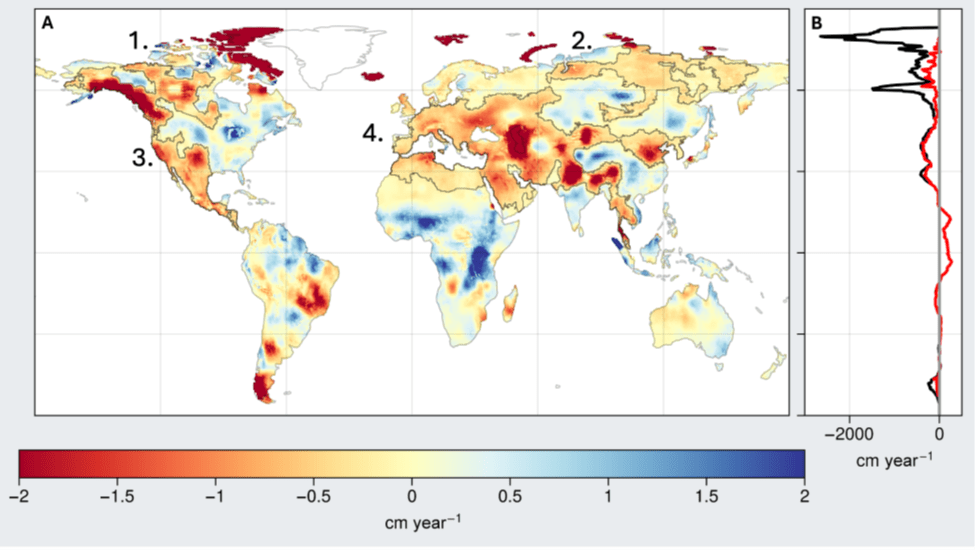
Figure 1. Global map of long-term TWS trends from GRACE/FO
Other authors have previously described the phenomenon of WW-DD, wherein wet areas get wetter and dry areas get drier. But now the dryer areas are getting drier faster than the wetter areas are getting wetter, and this began around 2013-2014. This time in an inflection period in global weather patterns, and coincides with a strong ENSO and coral bleaching event in the Pacific. At that time Hawaii suffered under real tropical weather, very light winds, high humidity, and tropical heat! I was watching the weather closely then and convinced myself that what I termed a “Global Thermal Mixing Event” was happening, an effect of enhanced differential heating. Hadley Cell circulation limits atmospheric mixing between latitudinal bands, and this event appeared to transfer an unusual amount of heat and moisture from tropical regions to temperature regions.
The authors point out that TWS is declining in high latitude areas irrespective of the changes in glacier and ice cover storage.
Another interesting point is that this reflects a departure in global terrestrial water storage. As the earth is a closed system, this water is going somewhere, and ultimately most of it ends up in the oceans, contributing to sea level rise. They estimate that this TWS contribution is now 44% of sea level rise with Greenland and Antarctica at about 37% and 19%, respectively.
The authors describe these five distinct DD areas, numbered above. The American West is within region 3. Europe-Asia has a giant drying region. Also, notice the Himalayas and the Aral Basin. the authors note that the blue in central Africa is partly the effect of an ongoing “pluvial” event, meaning a lot of rainfall over an extended duration.
The paper is available from:
https://www.science.org/doi/10.1126/sciadv.adx0298
It’s free thanks to AAAS.
Note: TWS accounts for loss of water storage through groundwater withdrawals, and I am curious how much of the overall groundwater budget this reflects.
Finally, I try to write something amusing so I will confess to one of the dumber professional mistakes I’ve made here. The project was siting a solid waste transfer station on the Big Island of Hawaii. I was given a set of criteria to evaluate sites with, and did my search, reducing the pool of hundreds of properties to a handful. I stupidly entitled it the Alternative Site Survey and handed the results out to a room of County staffers. I’d like to say that they, one by one, slowly broke into grins and then belly laughs when they realized the acronym, but no, they stayed quiet and presumably laughed behind my back. OK, lame story. Until next time. A hui hou.
 Graham Knopp's Blog
Please leave a comment. I will respond.