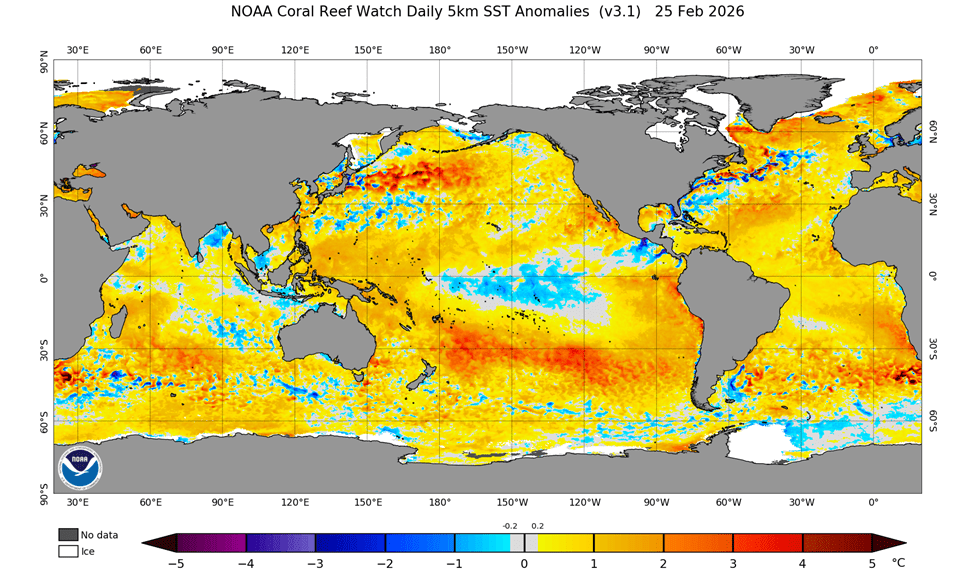
It’s late February and the sea surface anomaly map looks like this.

Yes, this is starting to get serious.
Let’s update a few other maps in this post.
Like drought.
Here’s the USA, and the much less important (irony alert, just to be sure), rest of the world.
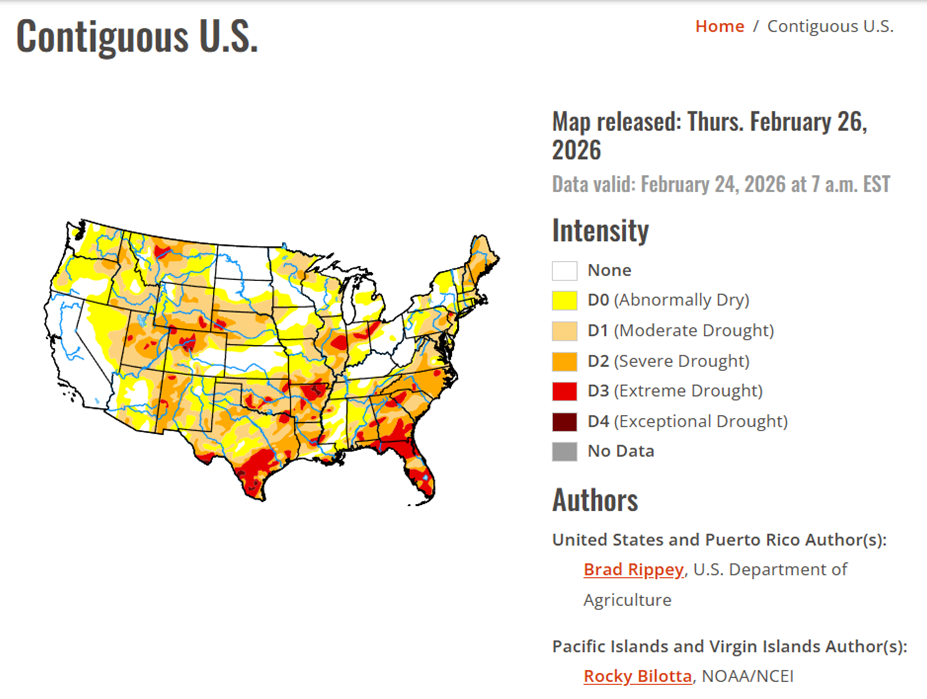
Not a great picture, but look at California there.
One key point we took from the GRACE/GRACE-FO data analysis papers so far is that the wet places tend get wetter and the dry places tend to get drier. But, so-called “pluvial” events, essentially short term (1-3 years) flooding events, are occurring within drying regions. So you see major rainfall events in places with drought. I’d say that we’re clearly seeing that, particularly in the southeast and parts of the west. Portions of the southeast that suffered from Hurricane Helene are now in drought.
We do expect California to be drying as well, and the current conditions, alleviation of long-term drought conditions over much of the State, is due to one of these pluvial events, and we can further expect that drying will resume.
Now I think of this information as based on fact and science, but there is a lot of uncertainty in the above paragraph, and what follows is more subjective and not quantitative at all.
I’m not a meteorologist and I don’t want to go into my qualifications here, since I already have.
But my understanding is that the jet stream is somewhat less stable than before. There is increased forcing of thermal transfer from equatorial regions to higher latitudes, related to overall changes in Hadley circulation and oceanic heat transfer. So the jet stream is not as regularly present to force low pressure systems to track regularly across north America, resulting in increased high-pressure ridging. This blocking high results in drought over much of the continental United States, but appears to also import more tropical moisture northwards at its margin, which is increased itself. My subjective view is that the northwesterly cyclones are following more varied paths, although on average more northerly.
Yes, perhaps you should move to Alberta. It’s full of fine people, bless their hearts. Don’t forget Saskatchewan, though. I hear Winnipeg is nice and bicycle friendly. Oh, wait, that’s Manitoba. My mistake. Saskatchewan is that big empty space between Alberta and Manitoba.
As an aside, I grew up farther north than 90% of Canadians, but we never acknowledged Winnipeg as a place you could go to. Perhaps that’s fair, and Winnipeg has absolutely no qualities, even though that Bob Odenkirk spy movie was apparently filmed there. I don’t know, but I would like to find out, and maybe repay Winnipeg its due, just for never realizing it was there at all. Back then, anything past Minneapolis or Duluth was far, but perhaps too near for a road trip, unfortunately. I made it as close as Lake of The Woods, about 100 miles away, as the crow flies. The internet tells me that Winnipeg has a vibrant arts community and is bicycle friendly. I’m cautious about the latter, but I’m sure an e-bike with studded tires is pretty fun in the snow.
So, change that. Make it Saskatchewan, as it has much more arable land than Alberta.
One question is whether the flood events from Hurricane Helene and other events can be described as pluvial events in the context of works like Chandrapurkhar et al. (2025)? I’ll get right on that.
But back to the SST anomaly map (at top). A related issue is uptake of thermal excess in the deeper oceans. Speculatively, it serves to reason that once heat content in the deeper oceans changes, then we will see changes in the major oceanic currents. This is a process that takes time, typically centuries or more. Now, we are starting to see some really good data on thermal uptake in the oceans, and that’s a meaty topic and not my strongest suit, although general oceanography is well-within the wheelhouse. And there’s a trillion dollar question, how can we expect changes in ocean currents, like the so-called Gulf Stream, which is a small part of the Atlantic (AMOC – the Atlantic Meridonal Ocean Current) conveyor, to change? Shutdown of the AMOC is considered low probability still (around 25%), but it is indeed slowing down.
These things do indeed take time, but the momentum is now rolling in that direction.
 Graham Knopp's Blog
Please leave a comment. I will respond.