And also, art history.
Richard Feynman said that unless you can explain something simply, you don’t really understand it. That’s the idea here, if you approach understanding things from fundamental principles and physical laws, you can develop an intuitive understanding of complex natural processes.
With that in mind let’s consider the topic of the north Atlantic “cold blob”.
What is it?
Does it disprove human caused climate change? Some people might use it as a “whatabout”, which is sad, because they’re not interested in getting at the truth of things and “truthiness” prevails.
The situation is a bit complex, and I’ll do my best to break it down.
Here’s a pretty recent global sea surface temperature map courtesy of NOAA.
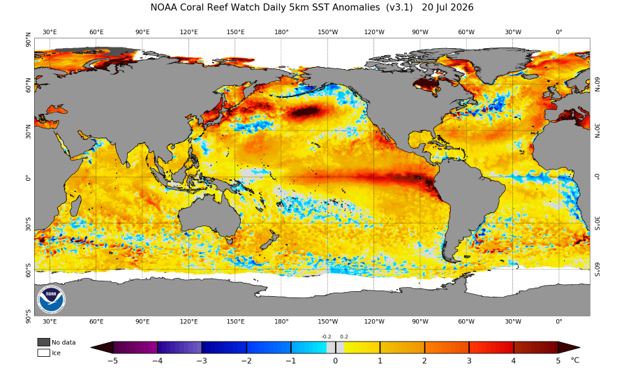
There it is, still south of Greenland. And it’s been around a while, since the 19th century.
Lenssen et al. (2024) show that while the oceans have warmed since 1880 (to 2025), this patch has cooled. In fact, it is anti-correlated with the south Atlantic temps. Weird.
A recent journal paper (Rahmstorf et al. 2026) states, “the cold blob” region is where the AMOC delivers its heat and passes it to the atmosphere, and much of this heat is drawn from the South Atlantic and transported northward across the equator . In fact, that is the main reason why the Northern Hemisphere is 1°–2°C warmer than the Southern Hemisphere (Feulner et al., 2013).”
The explanation is more complex, which is perhaps why they shied away from it.
Here’s the deal. In this area you have relatively fresh water from the Greenland Ice melt on the surface. This less dense, relatively fresh water overrides warmer, higher salinity AMOC water and mixes to some extent, in this area. A weakened AMOC reduces mixing, enhancing the cold blob.
The cooling explanation doesn’t make sense, on the face of it. Why would one region of the ocean be better at cooling than another? Which is to say that it’s complex.
Fan et al. (2025) try to reconcile the competing mechanisms by modeling the heat transfer, and found that the colder, drier conditions reduce surface IR warming.
Apparently, a weaker AMOC is associated with less warming in the area, and this feedback effect maintains cooler temperature. The colder temps cool the troposphere above and reduce this longwave downward solar irradiation by maintaining higher water vapor. If I am understanding things.
Walking back a little bit for a bigger picture, here is a public domain diagram of the oceans’ thermohaline conveyor system.
Deep water formation happens when water equilibrates thermally with the troposphere and becomes denser, then sinks. It’s a fair question to ask whether the little loop south of Greenland is real? Yes, and it is part of the North Atlantic Deep Water (NADW) system known as the Irminger Current. It is well-described, both chemically and spatially, and is conspicuous in part as it carries synthetic compounds like CFCs.
North Atlantic Deep Water – Wikipedia
https://en.wikipedia.org/wiki/North_Atlantic_Deep_Water
I should mention that the usually very conservative IPCC reports consider AMOC weakening likely at around 30% at this point, although with large 90% confidence factor (CF) error bars (around 30%, if memory serves).
Why is this important? Not to get too into the weeds, but the AMOC is a pretty good conveyor of heat, and if it weakens, it likely enhances warming but also complicates climate modeling, notably the parameter called climate sensitivity, or how much the Earth warms per unit change in atmospheric carbon and other GHGs.
Why is this important? Not to get too into the weeds, but the AMOC is a pretty good conveyor of heat, and if it weakens, it likely enhances warming but also complicates climate modeling, notably the parameter called climate sensitivity, or how much the Earth warms per unit change in atmospheric carbon and other GHGs.
AMOC strength also controls the European climate.
This makes me think about those 17th century Dutch master paintings of people ice skating. I recall one being mentioned in college coursework, but a search reveals that this was a common theme, with the 1610 painting (with the castle) by Hendrick Avercamp being one of the most widely recognized, along with the 1565 Pieter Bruegel the Elder painting Hunters in the Snow. Ice skating was a common theme with the Dutch Masters, but they depicted scenes that are quite rare in these times. So the suggestion has been made this this is an illustration of climate change, as Europe’s was then in a cold period known as the Little Ice Age. This period is attributed to AMOC weakening.
But is the disappearance of ice skating in the Netherlands really evidence of climate change? Or was it just more common in the Little Ice Age. This was also a time when the Netherlands was wealthy, and presumably people had time for leisure.
The River Avercamp depicted could be based on the Ijssel River, a tributary of the Rhine, which flowed through Kampen, where he lived. The Ijssel froze in 2021, enough for skaters to skate, but this was short-lived.
Apparently, ice skating is cultural for the Dutch, and at least one writer is suggesting that climate change is responsible for its demise.
Wikipedia: “Winter Landscape with Skaters is a c.1608 oil-on-oak painting by the Dutch artist Hendrick Avercamp in the collection of the Rijksmuseum in Amsterdam.”
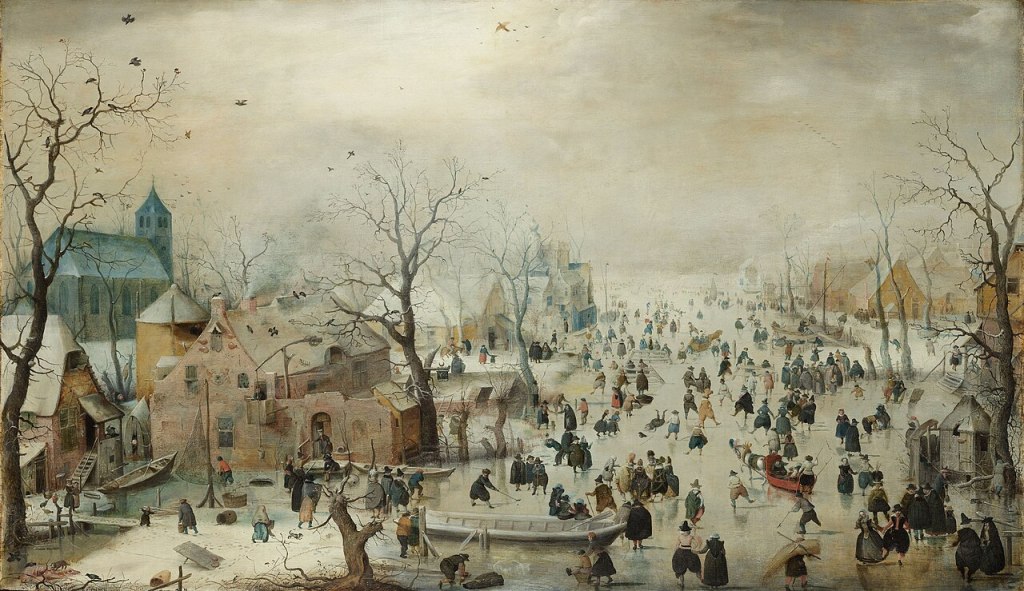
The Dutch may have invented the modern ice skates with metal edges, a vast improvement from the bone skates used as long as 5000 years ago in Scandinavia and Russia (Wikipedia), but ice skating was also an important part of my midwestern upbringing.
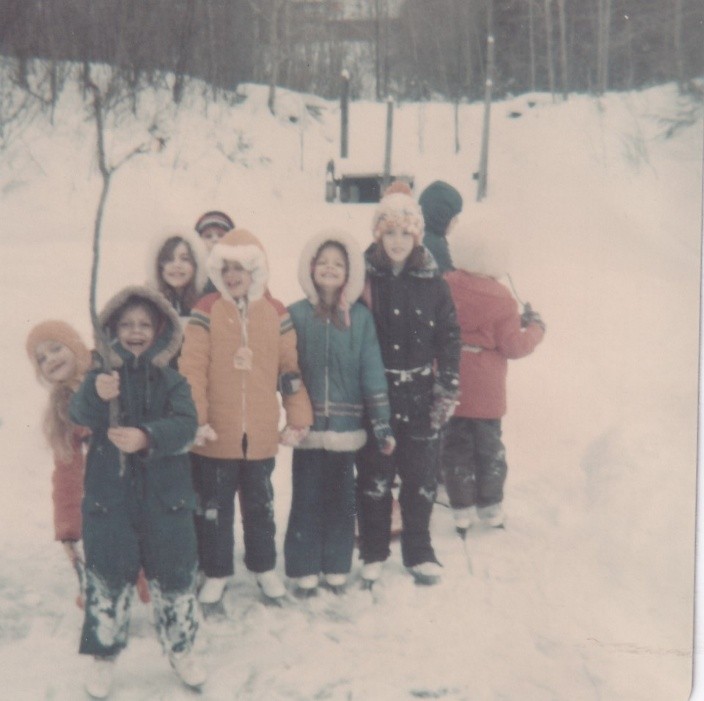
In those days, in north-central Wisconsin, once it grew cold in November, neighborhood parks sprouted ice rinks, the side boards emerging from storage somewhere. Or, we would go down to the pond. On winter days nice enough to get a group together and go down to the pond, this was a good way to find some sun in the middle of the open space usually lined with trees, as the sun obliquely found its way to the horizon.
I think I have a picture. Probably taken about 1977.
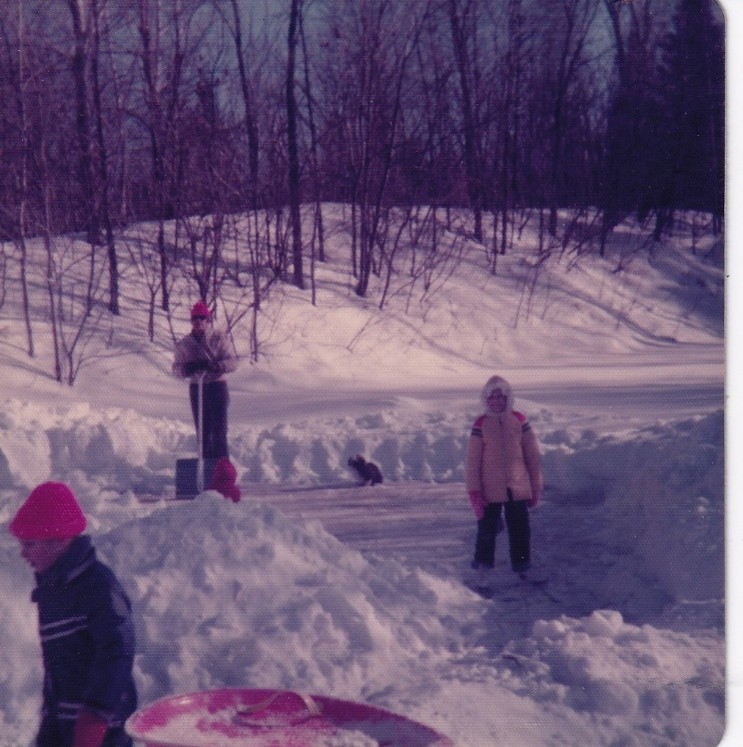
Sometimes you have to clear the ice.
On rare occasions, however, sometimes the weather would conspire to produce the perfect conditions with several nights of cold temps, maybe in the teens, and no precipitation. Then the ponds and lakes would be perfect, and ice skates the perfect vehicles for exploring. Just watch out for stream inlets and springs. The last time I did this was from the Lake Mendota shoreline in 1988. Out in the middle of the lake there was only a black void beneath me, the Madison skyline looking festive in the distance. Just avoid that pressure ridge coming off of the point.
The Netherlands has a marathon skating race called the Elfstedentocht, founded 114 years ago, but has been held only three times in the last 50 years.
Closer to home, and unrelated (directly) to the AMOC, neighborhood ice skating rinks have become rarer, for a number of reasons including risk and economics. But one paper found that the length of time that supports outdoor, unchilled rinks has indeed shrunk.
That paper can be found at:
Observed decreases in the Canadian outdoor skating season due to recent winter warming – IOPscience
https://iopscience.iop.org/article/10.1088/1748-9326/7/1/014028
References:
Yifei Fan et al., Subpolar North Atlantic cooling reinforced by colder, drier atmosphere with a weakening Atlantic meridional overturning circulation.Sci. Adv.11,eads1624(2025).DOI:10.1126/sciadv.ads1624
Feulner, G., S. Rahmstorf, A. Levermann and S. Volkwardt (2013). On the origin of the surface air temperature difference between the hemispheres in Earth’s present-day climate. Journal of Climate 26(18): 7136-7150 doi: doi:10.1175/JCLI-D-12-00636.1
Rahmstorf, S., Jendrkowiak, J., Gou, R., Cheng, L., Ruiz-Angulo, A., & Björnsson, H. (2026). Multidecadal Atlantic “warming hole” heat content variations are caused by ocean heat transport, not by surface fluxes. Geophysical Research Letters, 53, e2025GL118383. https://doi.org/10.1029/2025GL118383


Please leave a comment. I will respond.